

What Can Smart Cattle Ear Tags Tell You Beyond Location?
How lying, walking, daily activity, and digital headcounts help grazing teams decide what to check next.
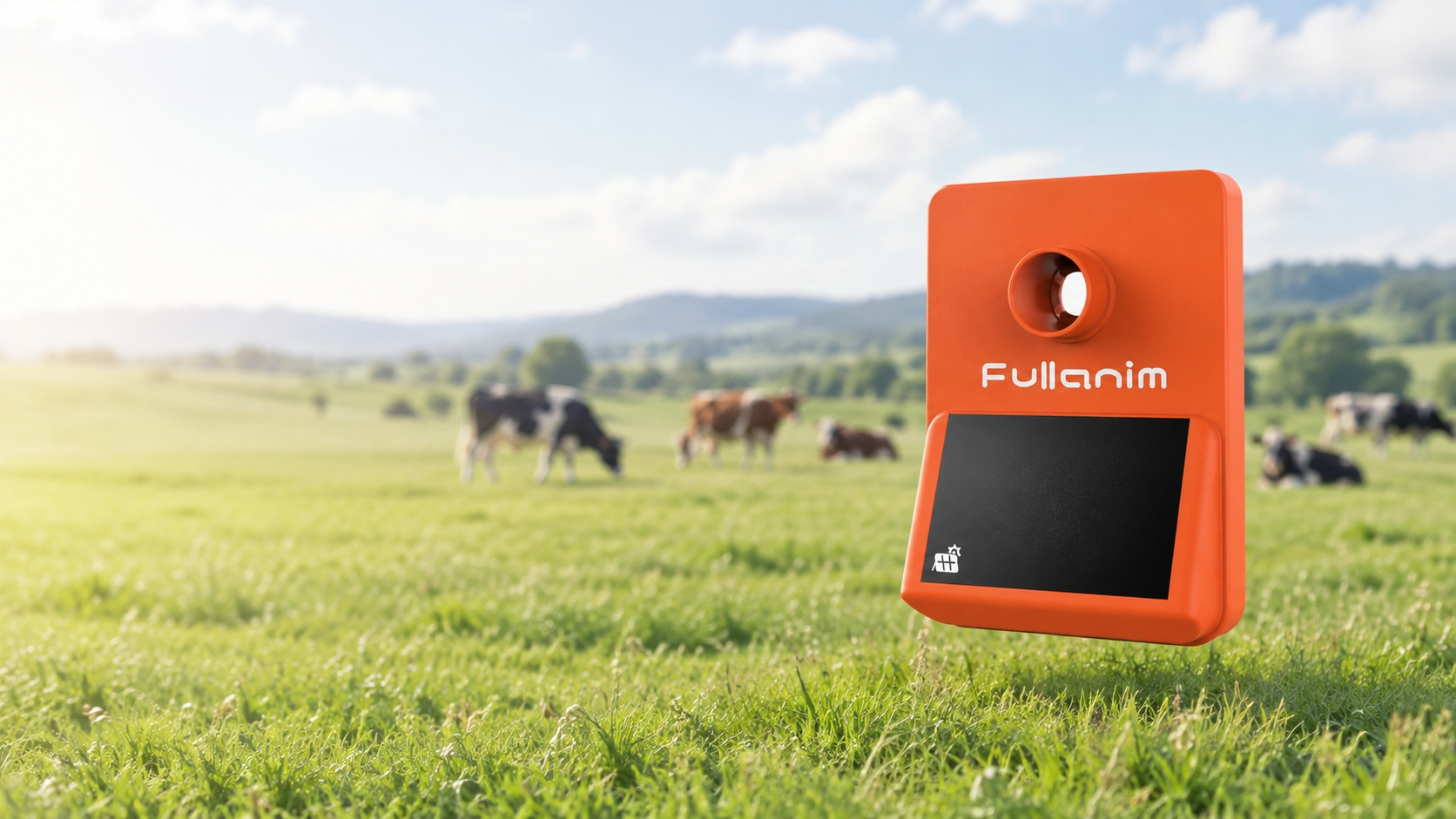
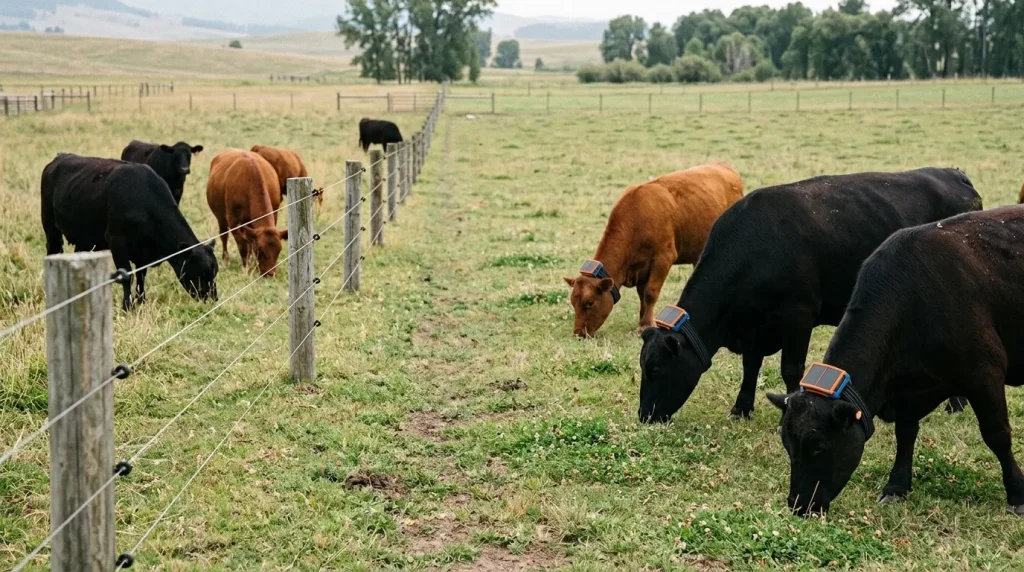
T005 product display with an illustrative pasture background; not an on-animal installation or customer site photograph.
A GPS pin answers one basic question: where was this cow when her tag last reported?
Out on the range, though, location is only half the story. Grazing managers usually need to know how the animal is doing. Has a cow’s daily routine shifted? Is the whole herd acting restless, or is just one animal lagging behind? Who needs a closer look on the morning pasture round?
Alongside GPS tracking, the Fullanim T005 GPS Ear Tag records lying and walking activity, daily movement trends, and data for Automatic Livestock Counting. Used together, these records help ranch teams prioritize field checks and keep tabs on herd inventory.
The key to getting real value from behavior data is treating it as a cue to look closer, not an automated diagnosis. A sudden drop in movement tells you which cow to find; it takes eyes in the field to tell whether she is lame, sick, calved out, or simply resting in the shade.
Beyond the Map: What the T005 Tracks
Not all smart ear tags measure the same metrics. Rather than promising every feature associated with the category, the T005 focuses on five practical data points:
| Metric | What It Helps You Spot | What to Keep in Mind |
|---|---|---|
| Lying records | Changes in recorded lying patterns. | Measures posture/resting patterns—not sleep quality, rumination, or clinical health. |
| Walking records | Changes in travel habits compared to recent days. | Tracks movement, which does not automatically equal grazing time or feed intake. |
| Daily activity | Broader day-over-day trends in overall activity and movement. | Requires consistent reporting windows and management context to compare fairly. |
| Location & movement | Where the animal was recorded and how territory relates to activity. | Periodic position updates are snapshots, not continuous live video. |
| Inventory records | Which tagged animals are actively reporting within a defined area. | Depends on accurate tag-to-animal pairing and recent signal check-ins. |
Note: Exact data fields, units, and dashboard summaries depend on your platform integration and configuration.
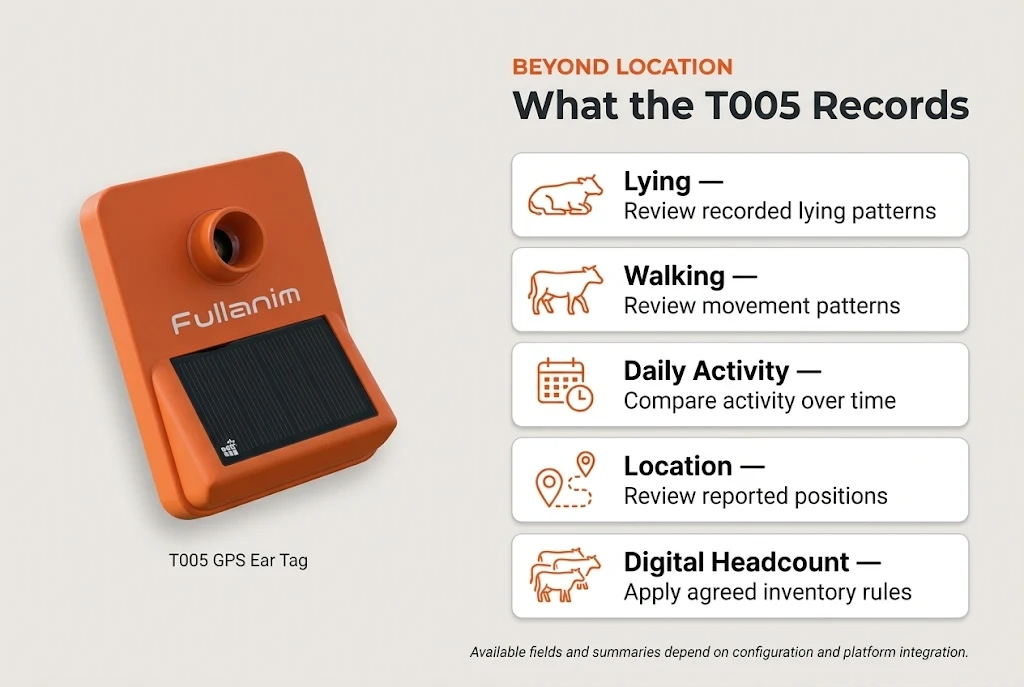
Available records depend on configuration and platform integration. Digital headcounts require agreed inventory rules.
Reading Activity Trends: Individual Cows vs. The Herd
Lying, walking, and daily activity numbers mean very little in isolation. A single quiet afternoon doesn’t prove a cow is sick, and a spike in walking doesn’t automatically mean she is in heat or gaining weight.
Instead of looking for a universal threshold, compare each animal against her own recent baseline—and against the rest of the group:
- When the whole group shifts together: Look at management and environment first. If walking spikes or lying time drops across the herd, check whether they were just moved to a fresh paddock, worked through the chute, or pushed by shifting weather.
- When one animal breaks from the group: If the herd stays steady but one cow shows a sharp change in lying or walking, put her on the list for a visual check.
As the University of Minnesota Extension notes on precision dairy farming, validating livestock sensors comes down to two questions: does the device accurately measure the physical behavior, and can that behavior reliably identify a specific condition? For the T005, the standard hardware provides lying, walking, and activity trends. Turning those raw trends into automated disease alerts, estrus detection, or calving predictions requires dedicated algorithms, validation samples, and custom platform rules—and never replaces a vet or experienced stockman.
Digital Headcounts: What “Counted” Really Means
Fullanim supports Automatic Livestock Counting as a core T005 application. However, before relying on a dashboard number, your team needs to agree on what a “count” actually represents in the system.
There is a big operational difference between:
- Total animals registered in your software
- Tags that have checked in within the last few hours
- Animals currently located inside a specific pasture boundary
Bookkeeping matters just as much as hardware. If a tag falls off, gets retired, or is moved to a new steer without updating the software, your digital roster will drift from reality. And, naturally, untagged calves or bulls won’t show up on the screen.
Treat a missing tag report as a prompt to investigate—not instant proof of a lost cow. Before sending a rider out, check whether the animal was recently moved, whether the tag is still assigned correctly, or whether she simply walked into a temporary terrain shadow.
Check Data Freshness Before You Ride Out
Before acting on an unusual activity chart or a short headcount, make sure you are looking at complete, up-to-date records.
By default, the T005 reports every 15 minutes. Keep in mind that the reporting interval is different from the onboard sensor sampling rate or the time window used to summarize daily activity. When reviewing your dashboard, pay attention to three details:
- Observation time vs. server arrival time: Don’t mistake a delayed upload or an old map pin for live, current behavior.
- Missing reports vs. zero activity: If a tag misses several check-ins, a poorly configured chart might make the cow look unusually still. Missing data is a connectivity gap, not a flatlined animal.
- Network coverage: The T005 transmits via a compatible LoRaWAN gateway connected to the internet. For tips on planning gateway coverage across rough terrain, see our guide on cattle GPS tracking without cell coverage, or read more about how GPS cattle ear tags work.
A Simple 4-Step Field Workflow
Data only saves labor when your team knows how to act on it. Whether you review records manually each morning or build custom alerts into your software, a practical routine looks like this:
- Verify the record: Confirm tag-to-animal pairing, check when the tag last reported, and make sure there are no missing data gaps skewing the daily summary.
- Factor in ranch activity: Check whether a pasture rotation, handling event, gateway outage, or weather change explains the shift.
- Inspect in the field: If an individual animal still stands out, locate her on the map and perform a visual health or pasture check.
- Log the result: Record what you found on the ground so your team—and your software—can refine future checks.
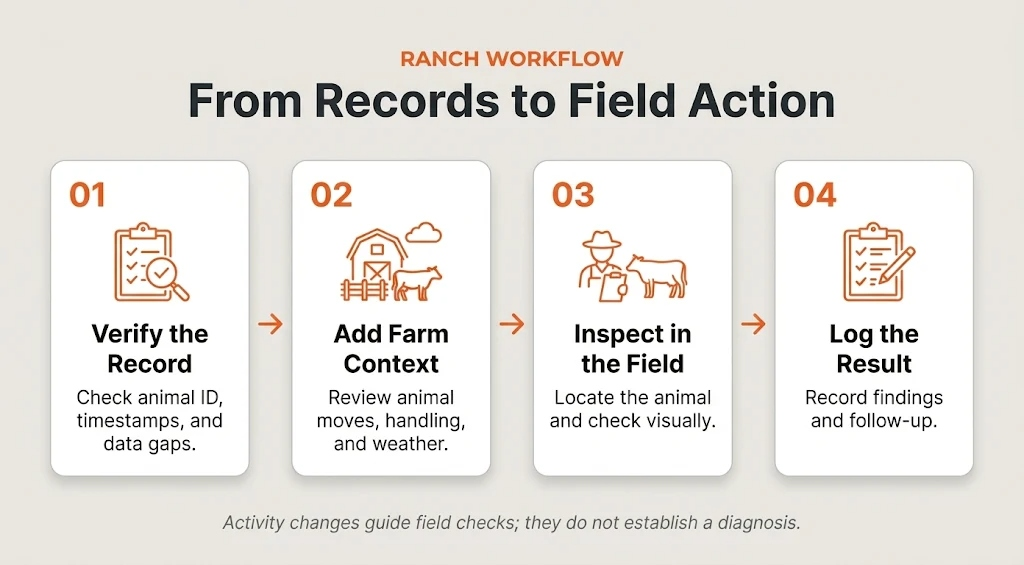
Use activity records to prioritize field checks and document what the team finds.
Running a Practical Pilot
If you are testing the T005 for grazing management or integrating it into an existing livestock platform, use your pilot to validate both the hardware and the day-to-day workflow:
- Lock down definitions: Confirm the exact data fields, units, sampling windows, and how the platform displays offline or delayed records.
- Clarify edge vs. cloud processing: For software and integration partners, confirm which calculations happen on the T005 tag itself and which must be built into your application backend.
- Ground-truth the data: Compare dashboard lying and walking summaries against real-world visual checks taken at matching times.
- Assign clear ownership: Decide who checks the dashboard, who rides out to verify exceptions, and how tag changes get logged.
Frequently Asked Questions
Do all smart cattle ear tags measure the same things?
No. Sensors, onboard algorithms, and field validation vary widely across brands. The T005 provides location, lying, walking, and daily activity records. Always confirm the exact data fields and interface specifications for your specific setup.
Does lower activity mean a cow is sick?
Not necessarily. First, rule out missing data or recent herd movement. If the drop is real and specific to that animal, use her GPS location to do a physical check in the pasture and consult a veterinarian if needed.
Can the T005 detect estrus or calving out of the box?
No. While activity changes often accompany heat or calving, the standard T005 specification provides raw behavior and activity records rather than pre-built reproductive alerts. Building automated estrus or calving detection requires agreed-upon algorithms and field validation samples.
Can digital livestock counting completely replace physical headcounts?
It reduces daily legwork, but shouldn’t blindly replace physical checks. Reliable digital counts require strict tag-to-animal record keeping, clear rules for what counts as “present,” and routine ground-truthing.
Plan Your T005 Deployment
The best way to scope a smart ear tag project is to start with the daily decisions your grazing team wants to simplify.
Tell us about your livestock type, pasture setup, target tag quantity, and software platform. Our team can walk you through the T005’s available data fields, LoRaWAN integration options, and recommended pilot steps.
Explore T005 monitoring features or email Fullanim about your project.


 Contact us by email