

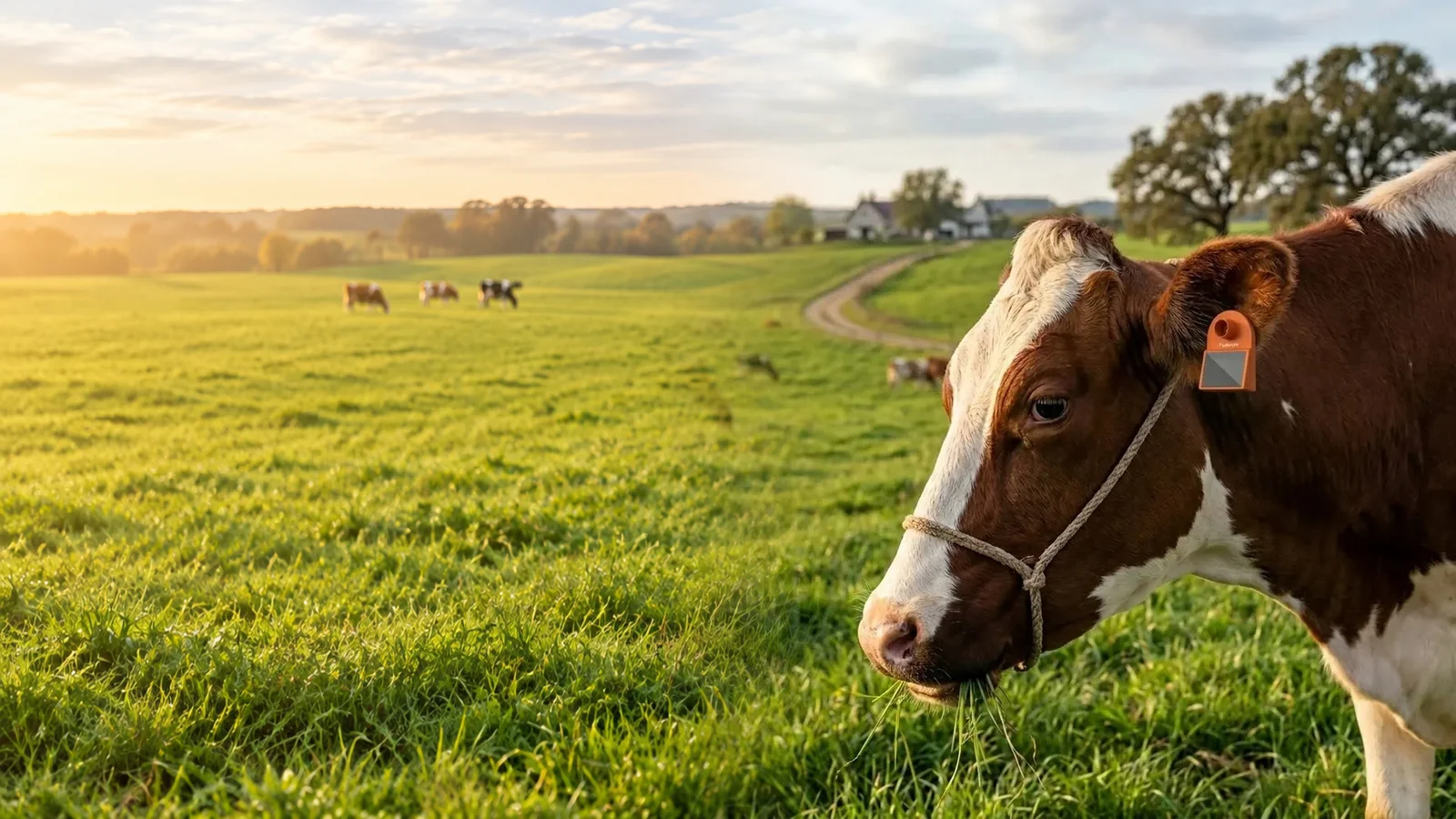
How Do GPS Cattle Ear Tags Work?
A practical guide to LoRaWAN connectivity, light-powered operation and pasture monitoring
Finding cattle across a large pasture is only part of a livestock-monitoring project. The other questions are practical: how will location data reach the farm team, and how much work will be needed to keep the devices operating?
A GPS cattle ear tag combines positioning with a way to communicate its data. For grazing operations, the power supply and communication architecture matter just as much as the location information itself.
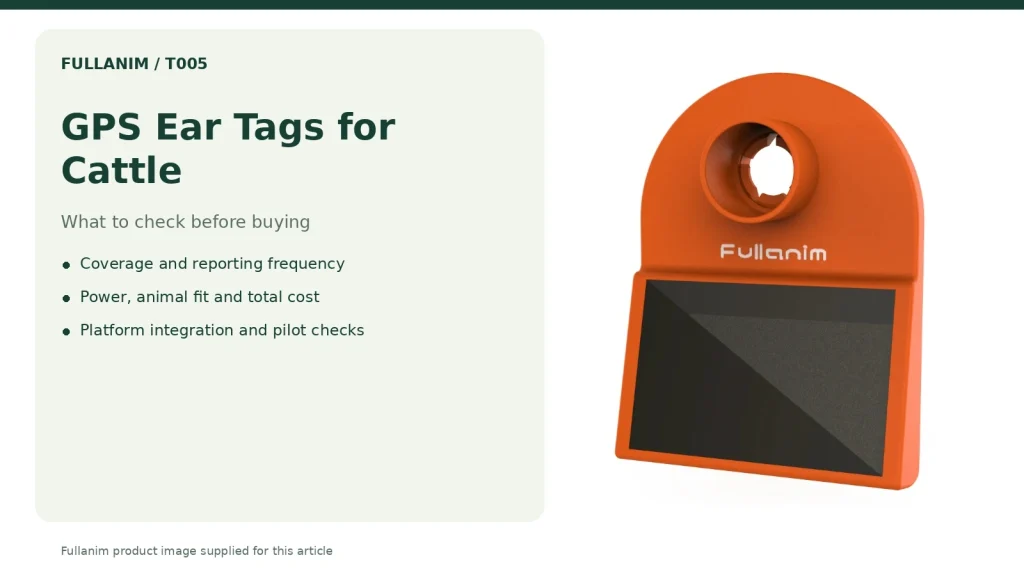
The Fullanim T005 GPS Ear Tag brings together light energy harvesting, LoRaWAN connectivity, location reporting and behavior monitoring. It is designed to support livestock location, herd inventory and review of lying, walking and daily activity patterns in grazing projects.
This guide explains how those elements work together—and what to check before deploying them in the field.
GPS and LoRaWAN: Different Jobs
GPS helps answer “Where is the animal?” A receiver uses signals from navigation satellites to calculate its position; this is a positioning function, not the connection that sends farm data to a dashboard.
LoRaWAN handles the next part of the journey. Its network architecture connects devices to gateways, which forward messages to a network server over an IP connection.
For T005, this means that the ear tag sends its data to a compatible LoRaWAN gateway rather than using a cellular SIM inside each tag. The gateway then uses the project’s backhaul connection to reach the server infrastructure.
In plain language: GPS provides the location; LoRaWAN carries the report off the animal.
From Ear Tag to Dashboard
The T005 reference architecture follows this path:
T005 ear tag → LoRaWAN gateway → Backhaul → Network server → Application services → Web or app
The tag reports device data over LoRaWAN. The gateway passes it onward using an appropriate backhaul connection, such as Ethernet, 4G or a satellite internet service. Network and application services then make the information available to the agreed platform.
This distinction matters when evaluating remote sites. Cellular coverage is not required at every ear-tag location for the tag-to-gateway link, but there must still be suitable LoRaWAN coverage and a working gateway-to-server connection. Connectivity has moved to a shared infrastructure layer; it has not disappeared.
Fullanim supplies the hardware and integration support. Gateway coverage, backhaul, platform ownership and delivery responsibilities should be agreed with the project partners before rollout.
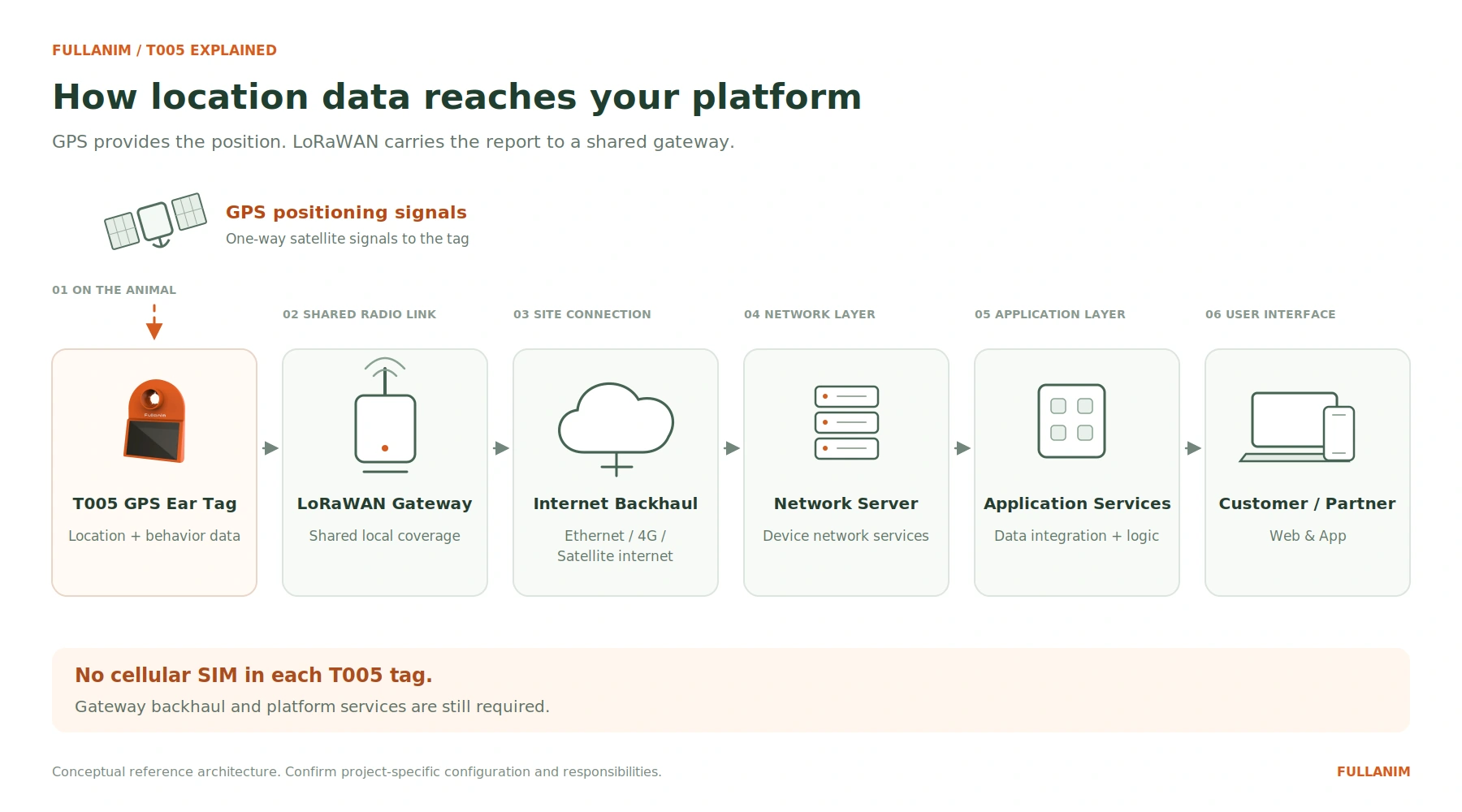
GPS positioning and LoRaWAN data reporting perform separate roles in a T005 deployment.
Why Shared LoRaWAN Connectivity Matters
A dispersed herd creates a connectivity-planning problem. With T005, multiple ear tags share gateway coverage rather than each carrying its own cellular SIM.
For a grazing project, that changes the questions to ask: where should gateways be installed, how will they be powered and connected, and what areas need to be tested before cattle are moved there?
It also changes the cost discussion. No cellular SIM in each ear tag does not mean a deployment has no connectivity costs. Gateways, installation, backhaul, network services and application services should all be considered in the project budget.
Fullanim lists a nominal tag-to-gateway range of about 5 km in open areas. This is a planning reference, not a promise that one gateway will cover every point within a perfect 5 km circle; the product page calls for coverage validation in the deployment environment.
A practical pilot should therefore test the actual grazing areas rather than rely on distance alone.
What Does Light-Powered Mean?
A remote monitoring device is less useful if the team must frequently gather cattle to service its power supply.
T005 uses light energy harvesting to replenish power while the tag is illuminated. Fullanim describes this as a way to reduce manual charging and battery-replacement work, with harvesting not restricted to direct sunlight.
The operational benefit is straightforward: replenishing energy on the animal can reduce the need for hands-on power servicing. However, this should not be interpreted as unlimited operation under every lighting condition.
For a project assessment, useful questions include:
- How much light will the tag receive in the actual grazing environment?
- Will animals spend long periods under shelter or dense cover?
- What reporting settings are required?
- What operating conditions support the supplier’s service-life figure?
- What checks are needed during low-light periods?
T005’s published nominal service life is five years. Treat that as a qualified product specification—not a five-year warranty or an unconditional promise of operation in darkness—and validate light exposure and reporting settings for the intended deployment.
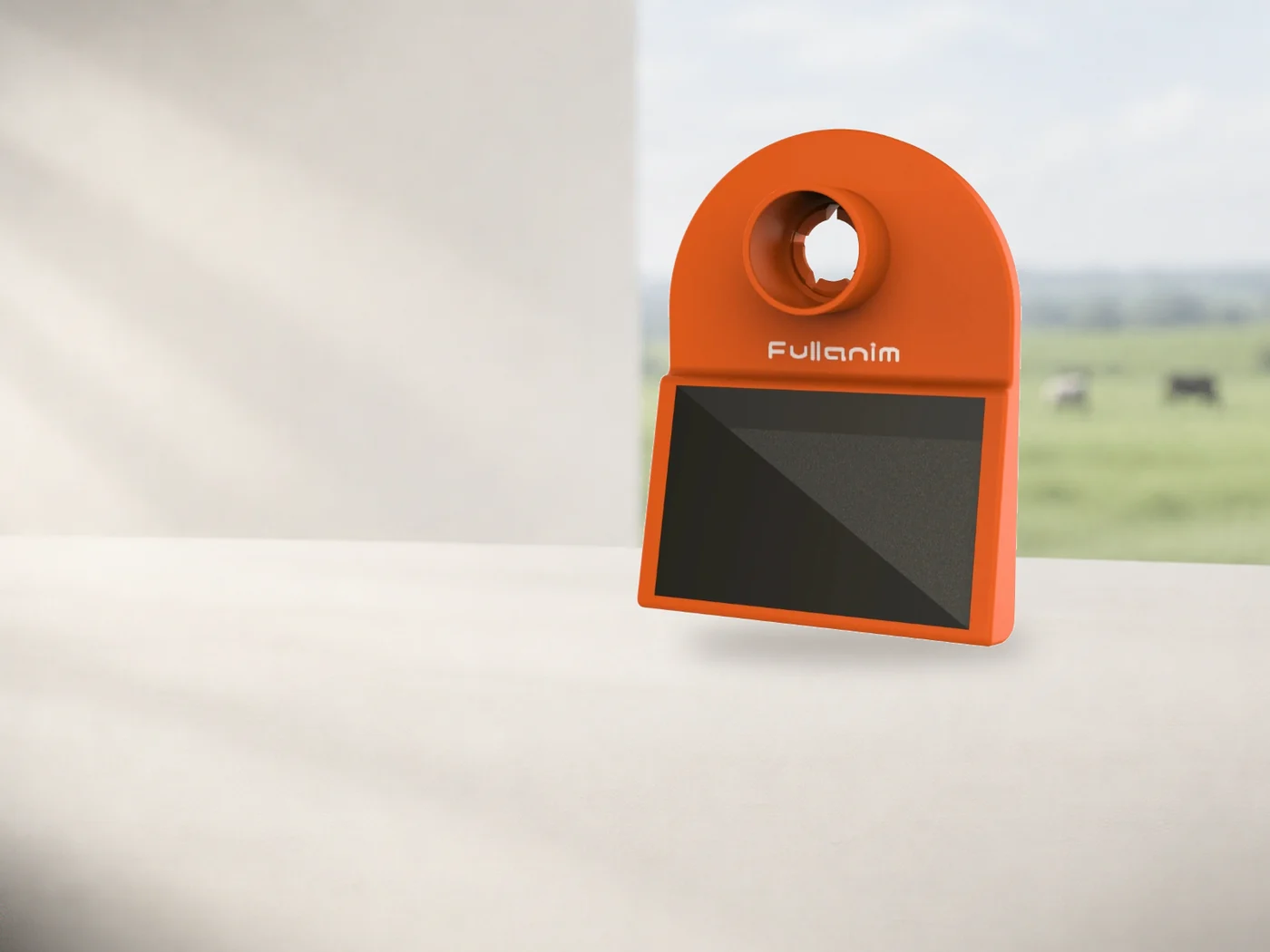
T005 uses light energy harvesting to replenish power while illuminated.
Location Reports, Not a Live Video Feed
T005’s default reporting interval is 15 minutes. That is the appropriate baseline when discussing the timeliness of its location reports.
Avoid treating a periodically updated map as continuous, second-by-second tracking. When reviewing a location, check the latest report time and confirm whether the platform is showing a recent update or an older record.
During a pilot, agree on the update frequency the operation actually needs. Also confirm what happens to data during a coverage interruption and how the platform identifies devices that have not recently reported, rather than assuming a particular offline-storage or recovery behavior.
Behavior Data for Follow-Up Checks
Beyond location, T005 provides lying, walking and daily activity information to help teams review behavior patterns and decide which animals may need closer attention.
The useful question is not simply “How much data is available?” It is “What will the farm team do when a pattern deserves investigation?”
A practical workflow is to review the animal’s recent records, consider relevant management events, check the animal and record the outcome. This keeps behavior information connected to a real task rather than leaving it as an unused chart.
The published T005 specification does not establish every possible reproductive or health application as a ready-made feature. Estrus, calving and health workflows require agreed algorithms and validation samples, and they do not replace veterinary assessment.
Supporting Herd Inventory
Fullanim lists Automatic Livestock Counting among T005’s applications, using location and movement records to support herd inventory, including projects spanning multiple grazing areas.
Before using a platform count operationally, define what it represents. Recommended questions include:
- Does it count registered devices, recently reporting tags or animals assigned to a particular area?
- How is a tag linked to the correct animal record?
- How are lost, removed or reassigned tags handled?
- How are stale reports and untagged animals shown?
These are deployment questions, not claims about an already confirmed T005 counting algorithm. Defining them helps prevent a digital inventory from being mistaken for an independently verified count of every animal physically present.
What the T005 Specification Tells You
| Published item | Fullanim T005 | Deployment consideration |
|---|---|---|
| Device | GPS ear tag | Confirm the target animals and fitting procedure. |
| Connectivity | LoRaWAN | Validate gateway compatibility and site coverage. |
| Power | Light energy harvesting | Assess light exposure and reporting settings. |
| Weight | 16.5 ± 0.5 g | Evaluate animal fit in the intended deployment. |
| Default reporting | 15 minutes | Confirm whether this suits the management workflow. |
| Nominal service life | 5 years | Review the conditions behind the nominal figure. |
| Nominal open-area range | About 5,000 m, tag to gateway | Validate on site; do not equate range with guaranteed area coverage. |
| Behavior information | Lying, walking and daily activity | Use trends to guide follow-up checks. |
The complete deployment still requires agreement on gateways, backhaul, network and application services, and the web or app experience.
Start With a Site-Level Pilot
A pilot should answer the questions that determine whether the system fits the operation. Before rollout, document the target livestock, grazing areas, reporting requirements and the people responsible for acting on the information.
Recommended pilot checks include coverage across the actual routes and paddocks, report freshness, light exposure, tag fit, animal-to-device records and the usefulness of the information to the farm team.
For platforms and integrators, also confirm the device data fields, interface requirements, network configuration and integration responsibilities. Fullanim offers hardware supply, custom development and customer-platform integration support, with the available scope assessed against the project’s requirements.
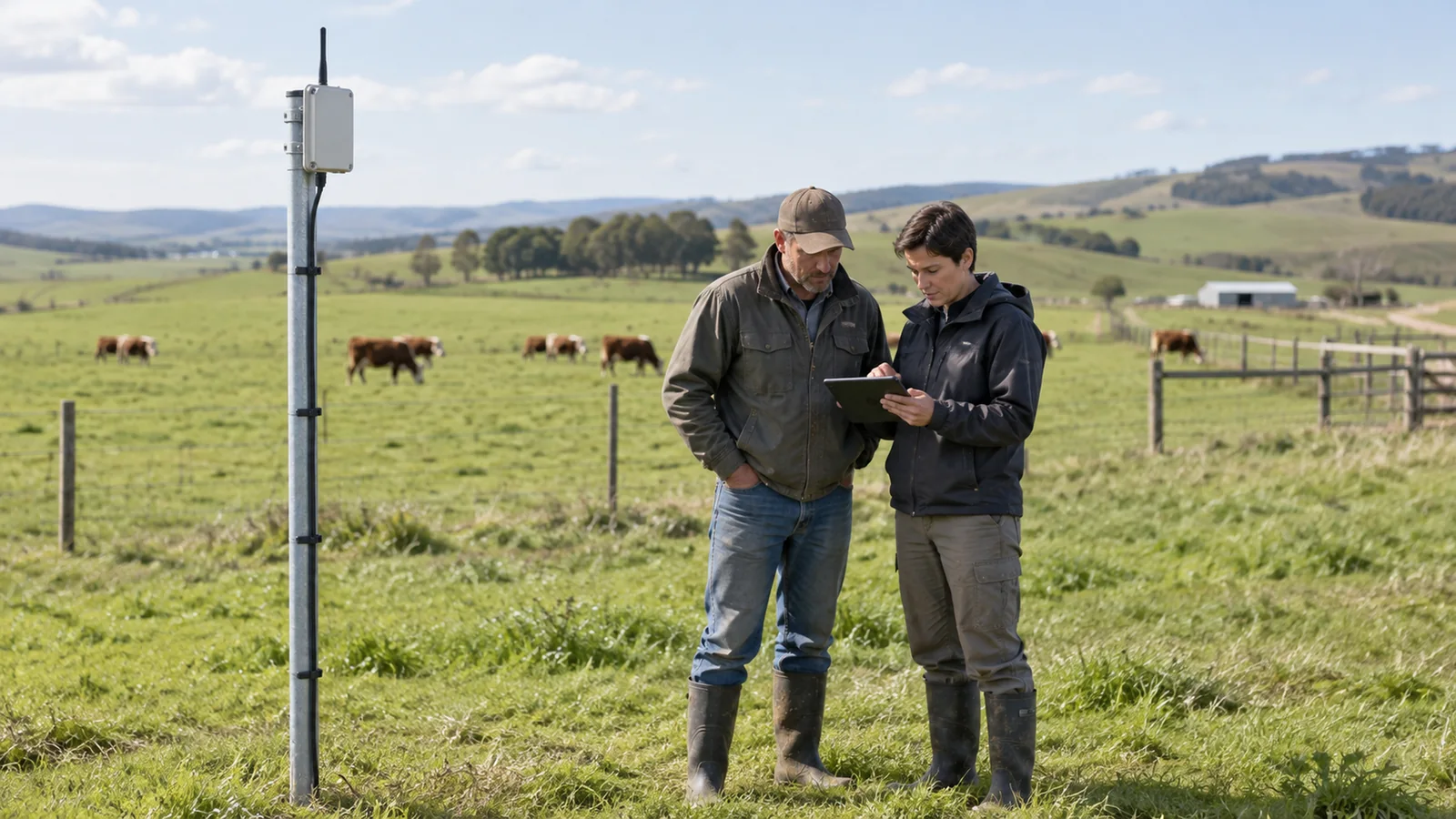
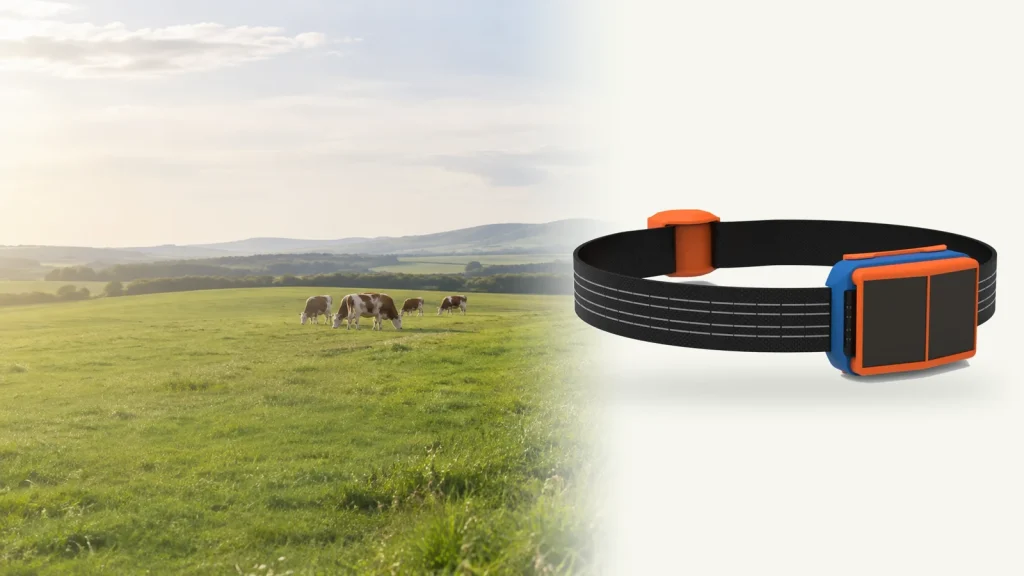
Illustrative deployment planning scene. Confirm gateway coverage and backhaul on site.
Frequently Asked Questions
Does each T005 ear tag need a SIM card?
No. T005 uses LoRaWAN for communication with a compatible gateway rather than a cellular SIM in each ear tag. The gateway still requires an appropriate backhaul connection.
Does light-powered mean direct sunlight only?
Fullanim states that T005 can harvest light beyond direct sunlight. Whether the available light supports the intended operation still needs validation; the specification is not a guarantee of sustained performance at any illumination level.
Is the five-year service life guaranteed?
The product page describes five years as a nominal service life and calls for validation of deployment conditions. Warranty terms should be confirmed separately.
Does T005 physically contain cattle?
The page describes electronic boundary monitoring, not animal containment through sound, vibration or electrical correction. Boundary monitoring should not be presented as a replacement for physical fencing.
Can T005 work with an existing platform?
Fullanim provides device communications, data interfaces and integration support. Share the platform and data requirements so that compatibility and the integration scope can be confirmed for the project.
Plan a Fullanim T005 Project
Choosing a GPS cattle ear tag means choosing more than a device. Power conditions, gateway coverage, reporting intervals and platform responsibilities need to fit together.
Fullanim supplies T005 hardware and supports project-specific development and integration, from engineering validation through volume production and delivery.
To start a discussion, share the deployment country, livestock type, estimated tag quantity, grazing layout, available backhaul and existing platform requirements.


 Contact us by email