

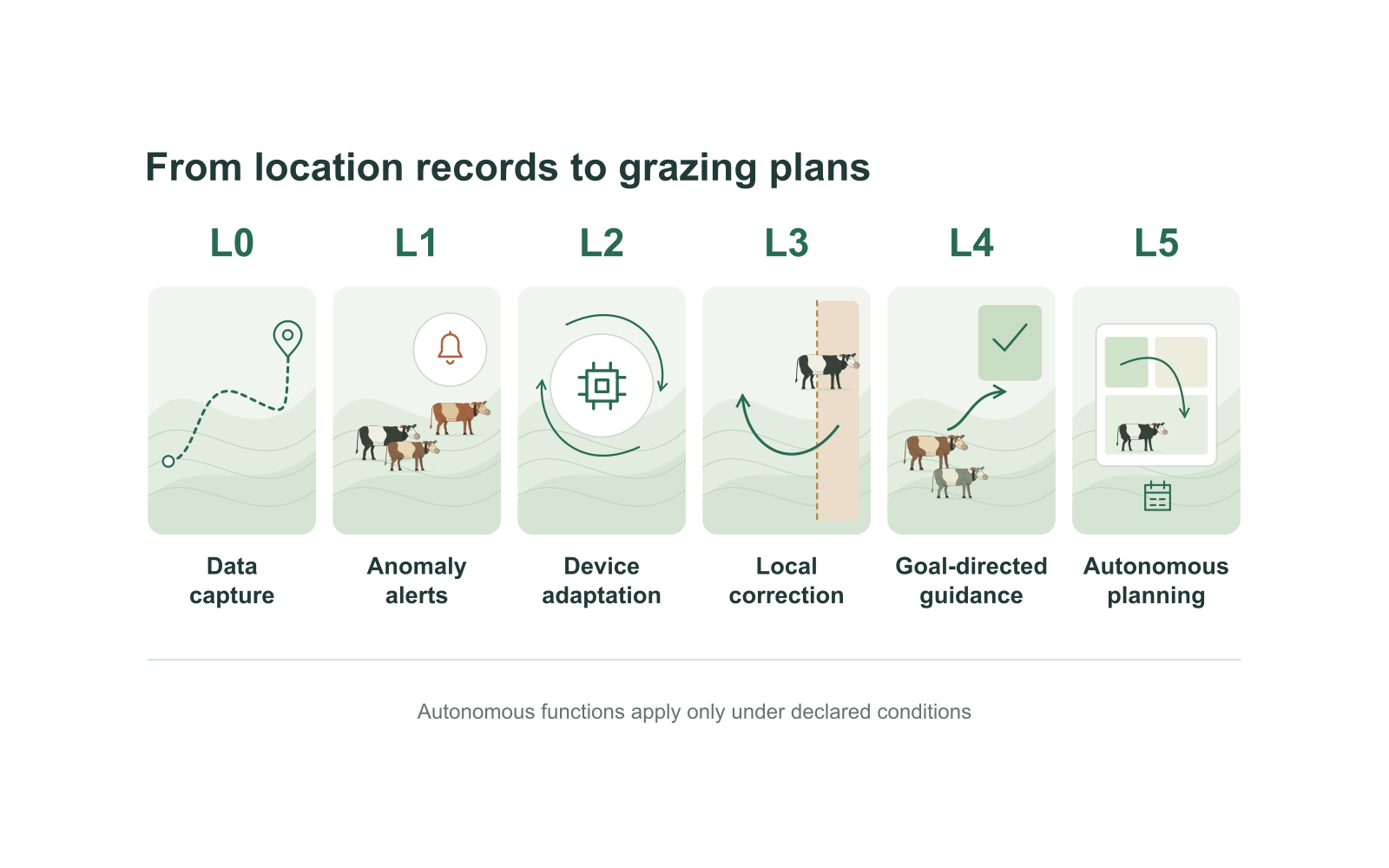
Do Grazing Wearables Have an “Autonomous Driving” Grade? One L0–L5 Table to Read Smart Grazing Devices
Fullanim releases the Automation Grading Specification for Grazing Smart Wearable Systems (V4) — borrowing the language of autonomous driving to give livestock wearables a yardstick anyone can verify
Before We Begin: The Autonomous-Driving Analogy Is Only a Mental Model
“L2 assisted driving”, “L3 autonomous driving” — mention L0–L5 and most people think of cars first: what the system can do on its own, and when a human still has to take over. Move those questions onto the ranch and ranchers ask almost the same thing: once my cattle and sheep are wearing smart devices, exactly which part of the work can they take off my hands?
The Automation Grading Specification for Grazing Smart Wearable Systems (V4), published by Fullanim, splits that question into six levels. From logging position and spotting anomalies, to local intervention and herd guidance, and on to grazing plans the system sets for itself, each step up has to say plainly which tasks the system has taken over and which still belong to people.
One thing must be said before anything else: the language can be borrowed, the levels cannot be converted.
L3 in grazing is not L3 in automotive driving. It has no mapping to GB/T 40429 or SAE J3016, and it is not grounds for claiming an “unmanned ranch”. What this specification measures is narrower and more concrete: under clearly stated conditions, which stretch of the grazing task the system can finish by itself, with results you can check. We borrow the vocabulary for one reason only — to make ranch requirements and system capability easier to line up.
What the Industry Lacks Is Not a Pricier Product, but Plain Language
Smart grazing wearables have been talked up for years, and terms like “smart grazing”, “virtual fencing” and “fully automated management” keep dropping very different capabilities into the same basket. One device only pushes a cow’s position to your phone; another raises an alarm when an animal strays; a third can move a herd to new pasture on its own. All of them are sold as “smart”, yet the work they actually take over can differ by several levels.
For a ranch the question is practical: products are everywhere, what is missing is knowing which level to buy. Do you only need to find the cattle and be told when something is wrong, or do you want the system to handle part of the job itself?
Manufacturers carry the same obligation: state under what conditions a capability holds, how it is verified, and who takes over when it fails. Without that, the conversation between buyer and seller slides back to spec sheets and who can shout louder.
Grading exists to give these questions a shared vocabulary. Positioning accuracy matters, but however precise the fix, it does not follow that the system can drive a herd; and just because a collar can beep, you still have to ask whether it knows if the cue worked, when to stop, and what to do when it did not.
Drawing on deployments across many kinds of ranches, Fullanim uses the complete task chain as its yardstick and sorts collars, ear tags and their supporting systems into six levels, L0 to L5. Whether you are choosing equipment, developing a product or simply talking to the industry, the capability has to be stated before solutions can be compared fairly.
A Second Point, Also Easy to Miss: Grading Is Not a Ranking
Grading measures which piece of the job the system finishes for you. If today’s headache is finding cattle and catching anomalies, solid monitoring is enough. If you also need to hold a boundary, call a herd back or run a rotation, look at the autonomy that goes with it.
Higher levels carry a more complete autonomous task chain, but the books cannot be balanced on the level alone. Devices, platform, connectivity, training, inspection, battery swaps, anomaly response — all of it goes into the account. A higher grade does not automatically mean cheaper, easier to maintain, or that people can stay away longer.
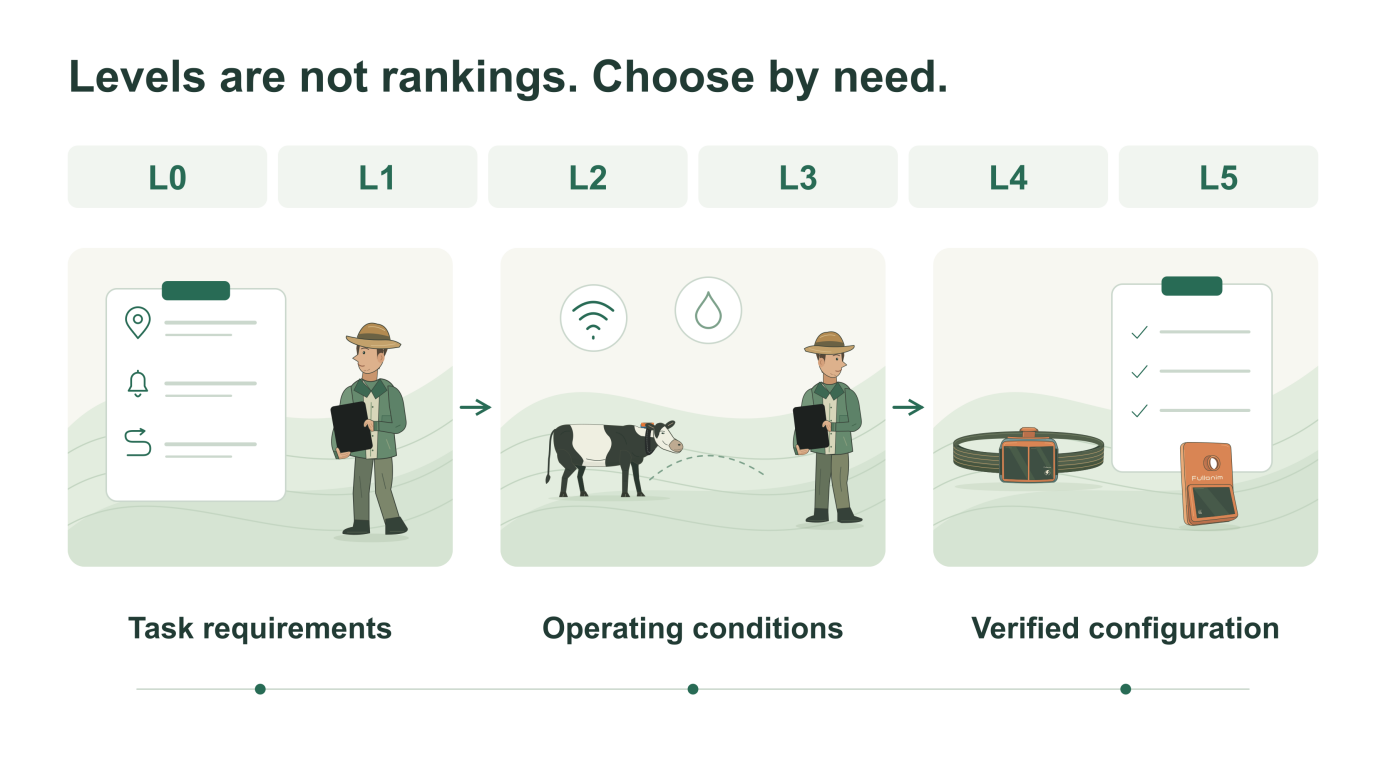
No level is obsolete; only a mismatch is expensive. Putting each device where it earns the most is what this specification is really after.
So sequence matters: write down what you need solved, then look at your pasture, herd, network and staff, and only then compare what suppliers claim. Get the need straight and the budget is far less likely to go astray.
First Rule: The Level Comes From the Closed Loop, Not From the Parts List
V4 lays down one core test.
Where the system configuration and the tasks are declared, the level shall be set by the highest complete task chain that the system can complete on its own, and verify, inside the declared Operational Design Domain (ODD).
Unpacked: the ODD is the range of conditions a supplier claims the system is good for; “complete” means key actions no longer wait for a person to decide each one. L0 and L1 are still open loop; the autonomous loop only closes at L2.
Three things are worth remembering.
- Positioning accuracy, radio type, sensor count, electric pulse or not — no single feature sets the level by itself;
- Collar or ear tag, the form factor does not correspond to a higher or lower level;
- However full the parts list, the system still has to meet every condition of that level and pass verification; a datasheet is not a task result.
V4 is equally clear that where the computing sits — cloud or device — does not set the level. Moving an algorithm into the collar does not add a level; what counts is whether it finishes the declared job on its own.
Nor does one task at a high level lift every function. Separate tasks are graded separately, and even the highest grade stays inside its declared ODD; it cannot be assumed to fit every ranch.
So buy in this order: start from your own situation, define the task and the level you need, then match a verified configuration. Before you commit, ask whether your pasture matches the declared scope, whether the facilities and the people will be there, and who takes over when something goes wrong.
Six Levels, One Thread: Four Closed Loops, L0 to L5
The whole system hangs on the idea of the closed loop: open loop → device closed loop → livestock-behaviour closed loop → grazing-objective closed loop. Four layers, six levels.
The four and the six do not line up one to one. L0 and L1 are both open loop, and the difference is whether the system judges anomalies at all. L3 and L4 both sit inside the livestock-behaviour loop; the difference is whether the system is correcting a local deviation, or running a whole guidance task with an objective, a process and a verified result.
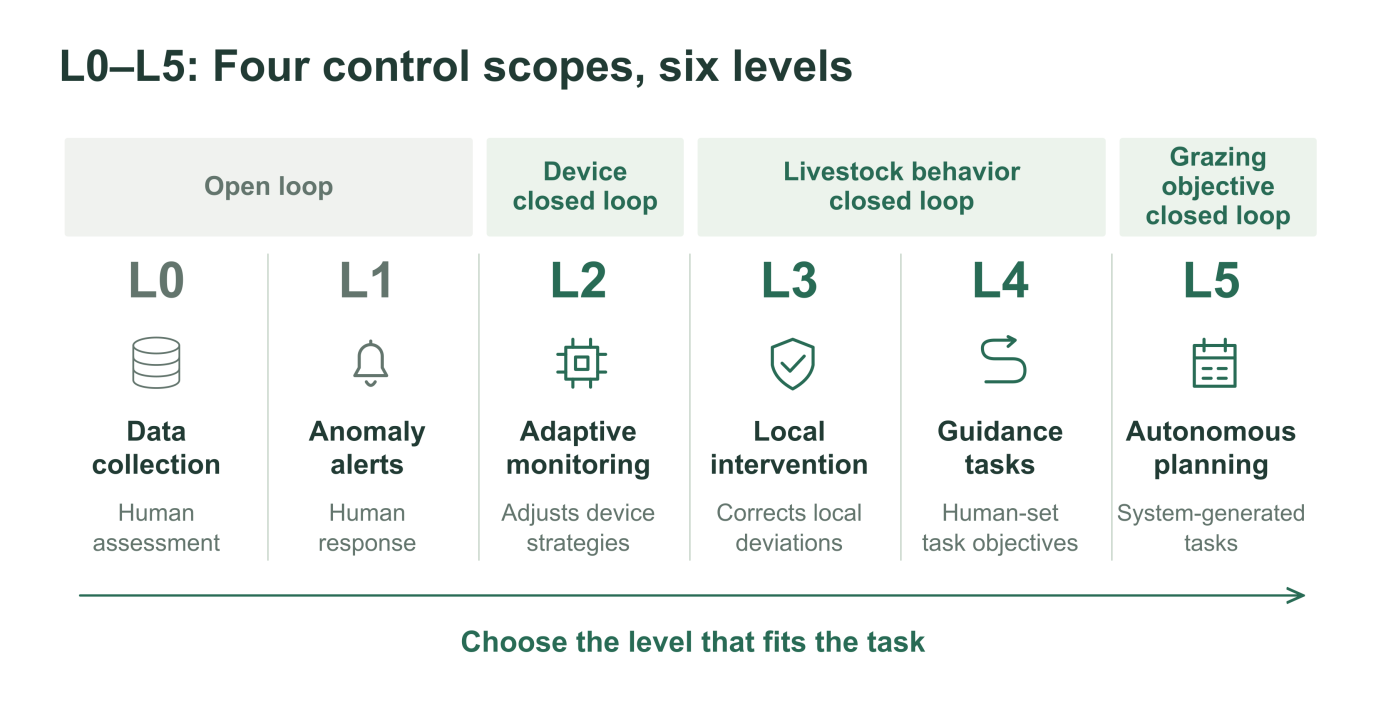
Take the table first, find the row that fits your job, then read the conditions under each level.
Table 1 The L0–L5 Capability Tiers at a Glance
| Level | Closed Loop | What the System Handles | Human Response | System Boundary | Typical Task |
|---|---|---|---|---|---|
| L0 | Open loop | Raw data collection and presentation | People arrange their own work | Class I and above | Position and trajectory queries |
| L1 | Open loop | Anomaly judgment and alerting | Ordinary alert ≤ 4 hours | Class II and above | Boundary breach, straying and similar monitoring |
| L2 | Device closed loop | Feedback adjustment of device strategy | Ordinary alert ≤ 2 hours | Class II and above | Local monitoring under weak-network conditions |
| L3 | Livestock-behaviour closed loop | Local constraint and correction | Takeover on constraint failure ≤ 30 minutes | Class II and above | Boundary keeping and restricted-zone control |
| L4 | Livestock-behaviour closed loop | Complete objective-oriented guidance | Ordinary guidance timeout ≤ 8 hours | Class II and above | Recall, herd transfer and segregation guidance |
| L5 | Grazing-objective closed loop | Plan generation, execution and adjustment | Major anomaly ≤ 1 hour | Class II and above | Grazing plans within operating constraints |
Read one rule before anything else: the human response times are outer limits that come with conditions, not a licence to wait that long. For any one event the shortest applicable limit applies, and when a constraint fails at L4 or L5 the 30-minute takeover limit applies too — the response still has to fit inside the safe time the site allows.
Read the boundary column with it. Class I is the wearable itself; Class II adds the necessary communication links and a management platform; Class III adds ranch facilities that take part in automatic control. L0 can be Class I or above, L1–L5 need at least Class II, and Class III is declared only where automated facilities are genuinely in the loop.
The phrase that matters is “takes part in automatic control”. A passive fence around the boundary can be good safety practice, but on its own it does not make the system Class III.
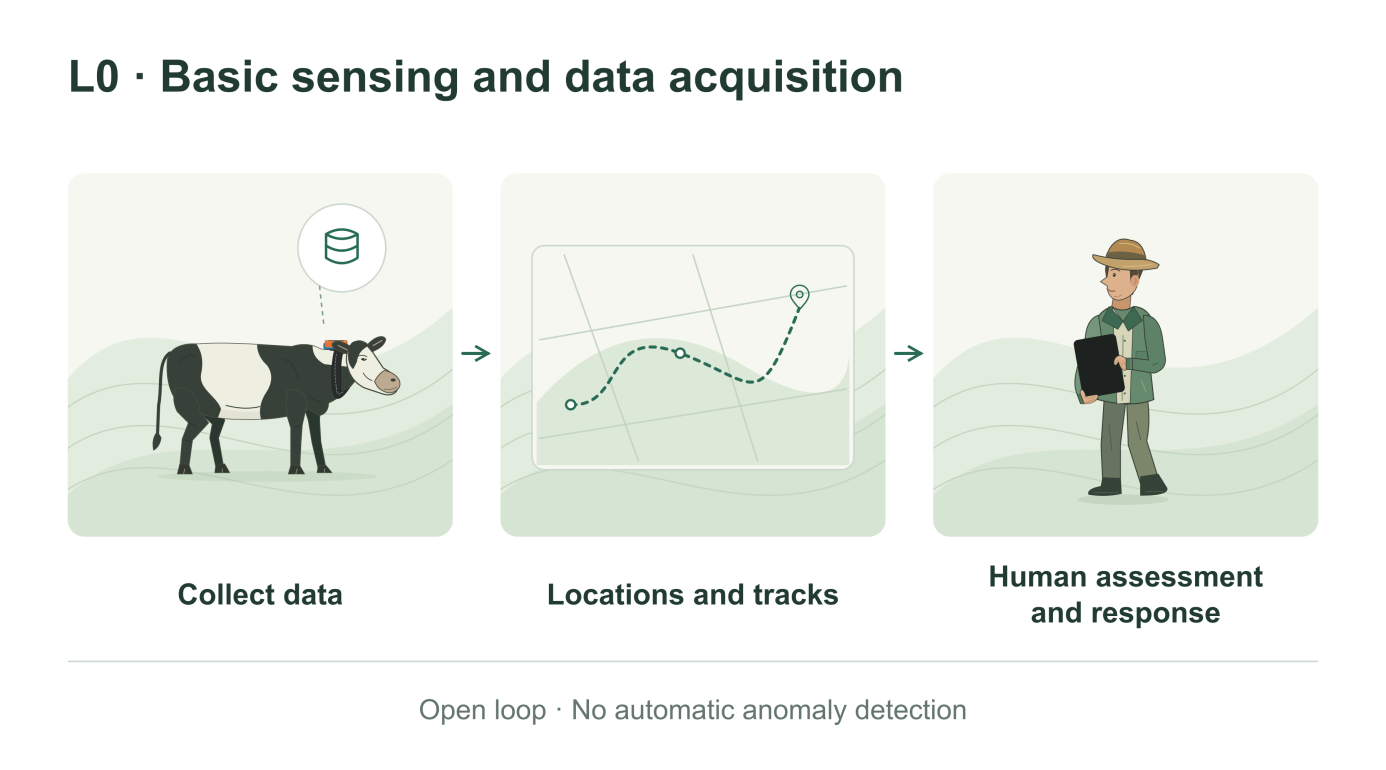
L0 Basic Perception and Data Collection
Closed loop: Open loop. The system collects, stores, transmits or presents raw measurements such as position, trajectory and movement. It does not judge livestock anomalies, and it does not output any handling result of its own.
What the system handles: Record the raw data and hand it over in the declared manner. Where position can be viewed remotely and trajectories replayed, the platform and connectivity it depends on must be stated; where data can only be read locally, declare it as it is.
What people handle: Read the data, judge the situation, decide what to do. A dot on a map only means you can see a position; it does not mean the system has judged whether that cow is in trouble.
Where it fits: Small housed herds, temporary agistment, and low-cost starts where the budget is tight.
Why it matters: It puts position and trajectory on record. Whether the data is timely, how large the error is and how gaps are shown all need checking. For a modest ranch on a limited budget, first ask whether it genuinely cuts the time spent looking for cattle, then decide whether the money is well spent.
L1 Platform Monitoring and Alerting
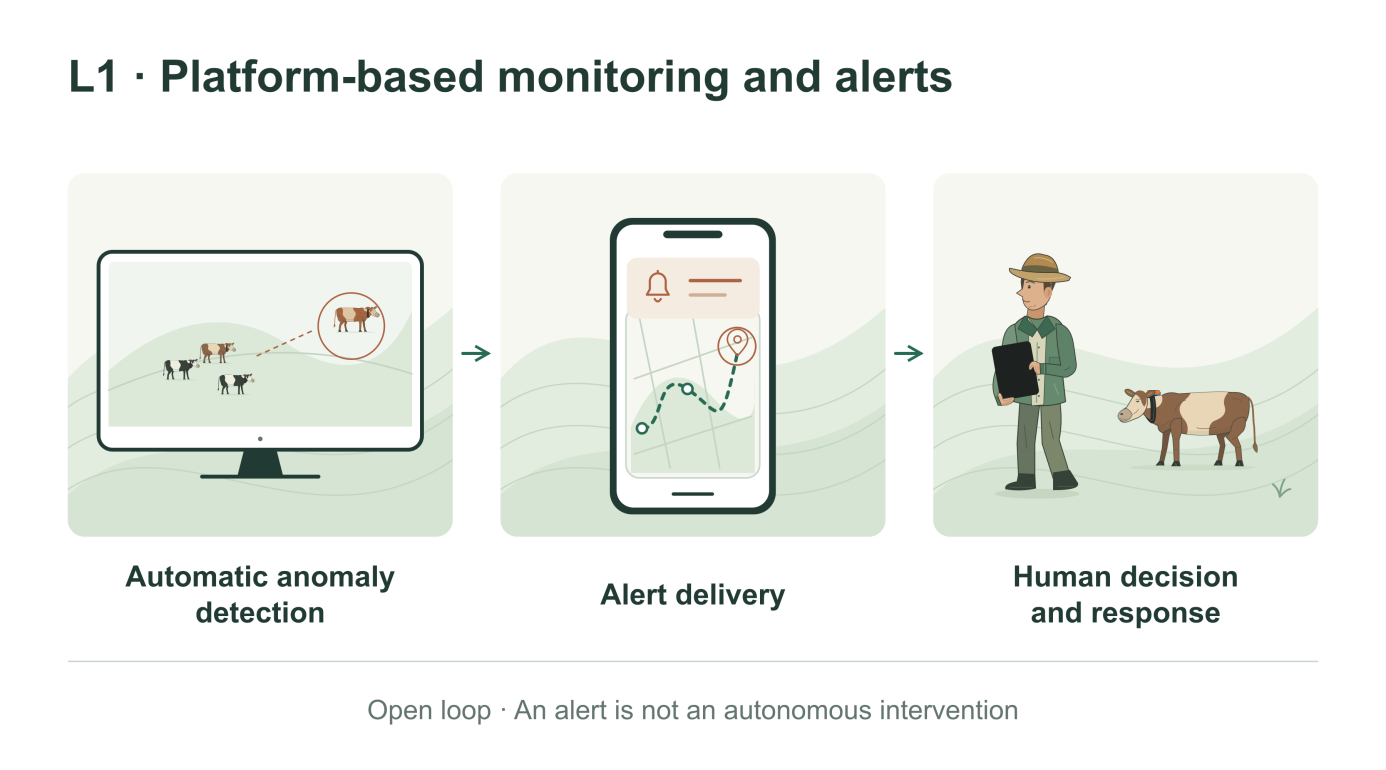
Closed loop: Open loop. The system judges anomalies automatically; people decide what to do and carry it out.
What the system handles: Spot the declared anomalies — boundary breach, straying, prolonged immobility — under preset rules, and get the alert out. Against L0 it has moved from showing you data to telling you something is wrong. But if a person still has to click somewhere before the alert fires, that is manual operation and cannot be written up as autonomous intervention.
What people handle: Judge and respond once the alert arrives. The limit for ordinary monitoring alerts is 4 hours; where an urgent risk is involved a shorter limit applies and on-site safety requirements must still be met.
Where it fits: Ranches that need anomalies caught promptly and have people able to respond as required.
In plain terms: A sentry posted on your herd. It finds and it tells you; the authority to act stays with people.
Whether this level is worth paying for comes down to how accurately it reports and how much it misses. The specification sets a 90% threshold for both alert precision and anomaly detection rate, and checks the corresponding confidence lower bound, detection latency and delivery path. A phone ringing is only the first step.
L2 Edge-Side Autonomous Monitoring and Adaptive Reporting
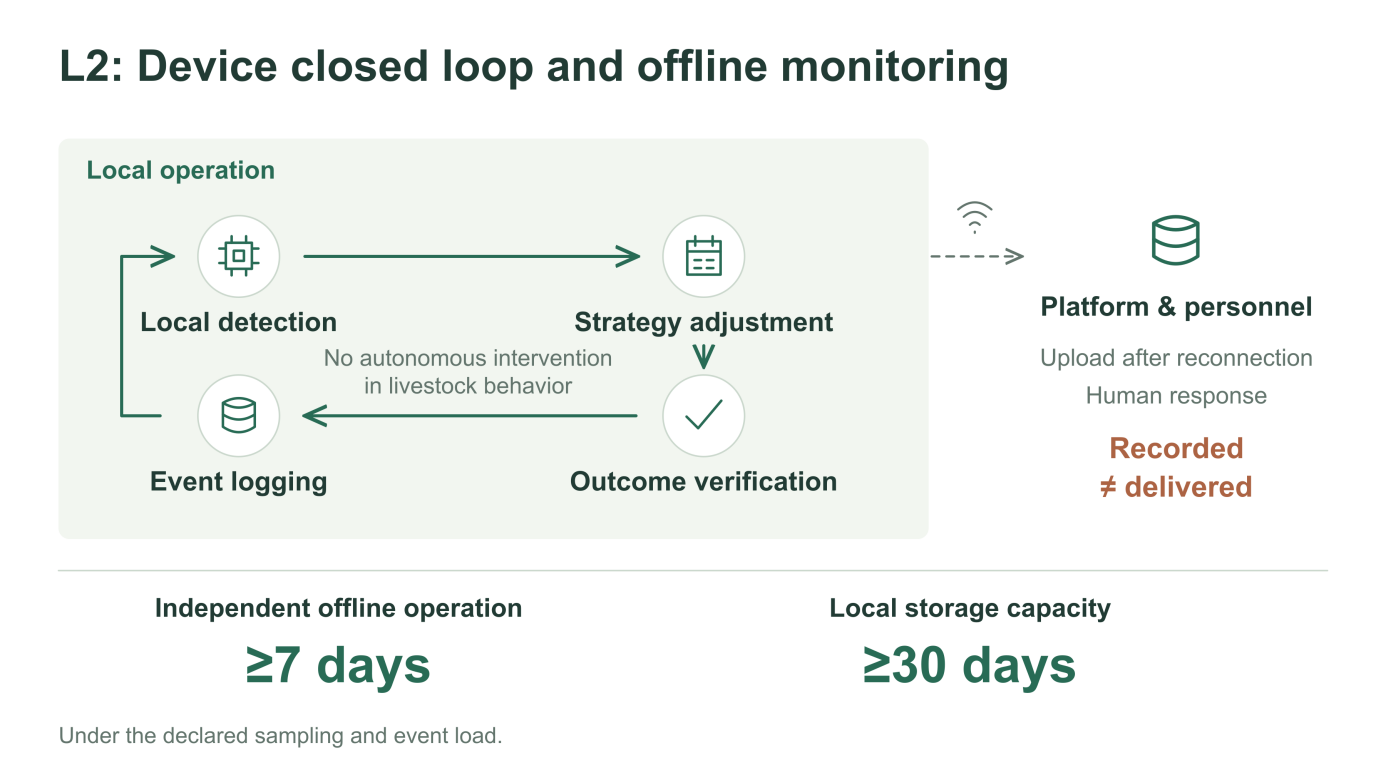
Closed loop: Device closed loop. Based on on-site conditions together with communication and energy status, the system adjusts its own sampling, event recording, reporting or communication strategy and verifies the result. It does not intervene in livestock behaviour.
What the system handles: Local recognition, strategy adjustment, offline recording and deferred upload, tied into one sequence. The point is not whether the words “edge computing” appear in the brochure, but whether the device can judge why it needs to adjust and whether monitoring still holds afterwards.
Minimum capability: Under the declared sampling and event load, at least 7 consecutive days of independent operation without a network, and local storage for events and trajectories covering at least 30 days. These two figures are not the same thing: one is how long it can work, the other is how long a span of data it can keep, and both have to be verified.
What people handle: Livestock anomalies are still yours to handle, with a 2-hour limit on ordinary alerts. While the network is down the device may keep recording, but whether the message reaches a person far away depends on a backup link or a takeover arrangement.
Where it fits: Large-scale extensive grazing, transhumant grazing, and pastures where coverage is weak.
In plain terms: An on-site duty officer that changes its own working method and keeps the record going even when the network does not.
Why it matters: On natural pasture with unstable signal, whether monitoring simply continues often counts for more than a few extra functions on a spec sheet. But “the device recorded it” and “the person has the message” are two different things, and an offline solution has to explain that hand-over.
L3 Local Autonomous Intervention
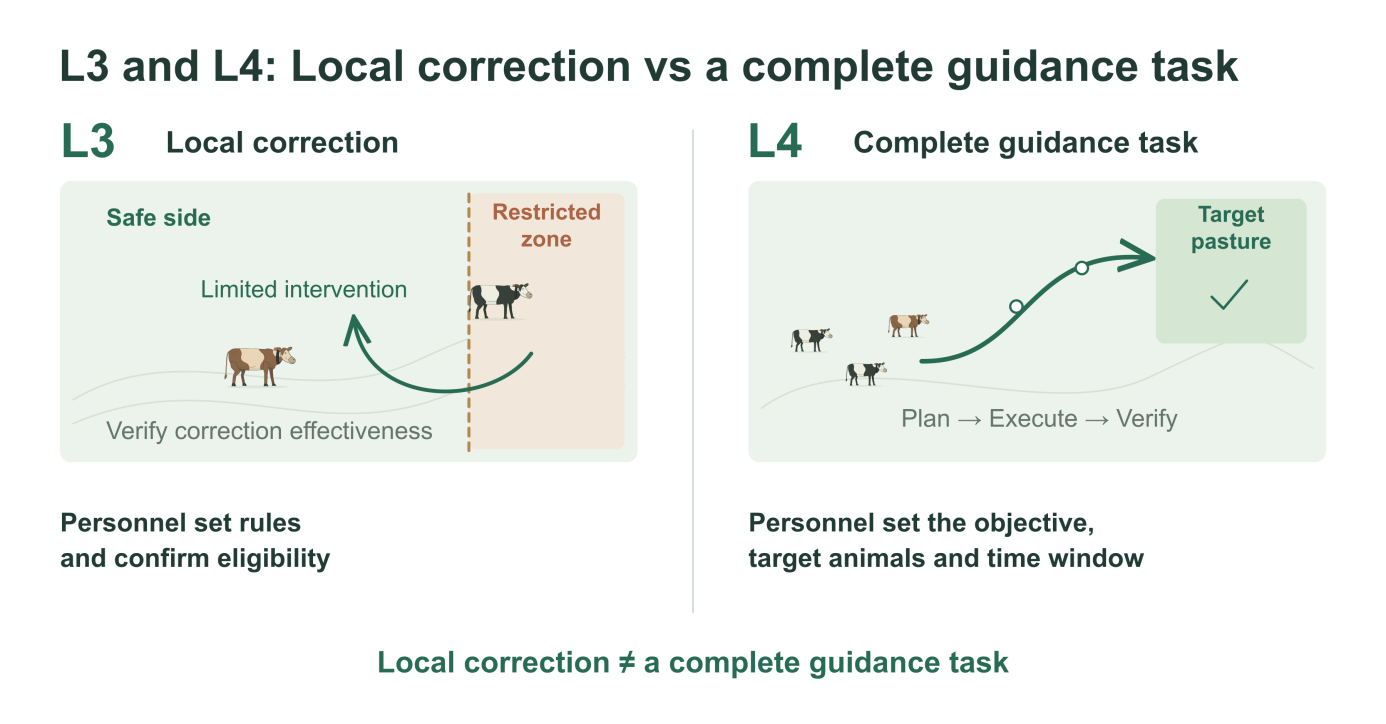
Closed loop: Livestock-behaviour closed loop. Around a defined constraint the system runs the full sequence — anomaly identification, decision, limited intervention, effect assessment, event record — and corrects the local deviation.
What the system handles: Under verified conditions, hold a boundary or keep animals out of a designated area. Once a cue has gone out it must still know whether the animal responded, when to stop, and how to alert and hand over if the cue failed. Neither electric pulses nor lead-animal identification are necessary conditions for L3.
Key dividing line: L3 is about pulling a deviation back into line. Guiding an animal that has crossed the boundary back to the safe side may still be local correction. Whether it has reached L4 depends on objective-oriented process planning and end-to-end verification; spotting the words “return” or “move towards” proves nothing.
What people handle: Set the rules, confirm eligibility and take over when needed. When a constraint fails and a person has to step in, the limit is 30 minutes, and a shorter one applies where on-site risk demands it.
Where it fits: Ecologically sensitive areas, and pastures with strict boundary control that also have external safeguards in place.
Why it matters: The system carries part of the boundary-keeping and local-correction work. But do not stop at whether an intervention was issued — ask whether it worked. The intervention success rate threshold is 85%, the applicable learning qualification rate 90%, and the related monitoring indicators must be met as well.
Animals that fail to learn are withdrawn from automatic intervention. After a failure the system moves into a restricted or task-stopped state according to what it can still do; saying it “falls back to L2 automatically” is not an explanation.
L4 Local Autonomous Behaviour Guidance
Closed loop: Livestock-behaviour closed loop. A person sets the objective, the target animals and the time window; the system plans and executes the guidance, keeps checking progress, safety constraints and the outcome, and adjusts the route or stops the task when it has to.
What the system handles: Guiding a designated herd to a target grazing area, for instance. The system must know more than the destination: it follows progress on the way, notices stragglers, handles changes of route and confirms at the end that the task was actually completed. A person may set the objective in advance; if every key action still needs a person’s approval, it is not autonomous guidance.
How to read the sub-levels: L4a covers a single animal or a group of no more than 10 head at a time; L4b covers more than 10 head at a time, or coordinated scheduling of several herds. How large a group it can move, whether it can split a herd and how many tasks it can run at once each have to be verified separately; one “L4” label does not cover all of it.
What people handle: Set the objective, provide what is needed, and handle what the system cannot. The 8-hour limit applies only to an ordinary guidance timeout that raises no immediate safety or welfare issue.
Where it fits: Ranches that need recalls, herd transfers or segregation guidance.
Why it matters: A complete guidance task is handed over for the system to run. The success threshold is 80%, and the relevant L3 requirements must hold at the same time. One account is easy to get wrong: individual arrival rate and task success rate are counted separately, so “80% of the cattle arrived” is not the same as one task passed.
Why 30 Minutes for L3, but 8 Hours for L4?
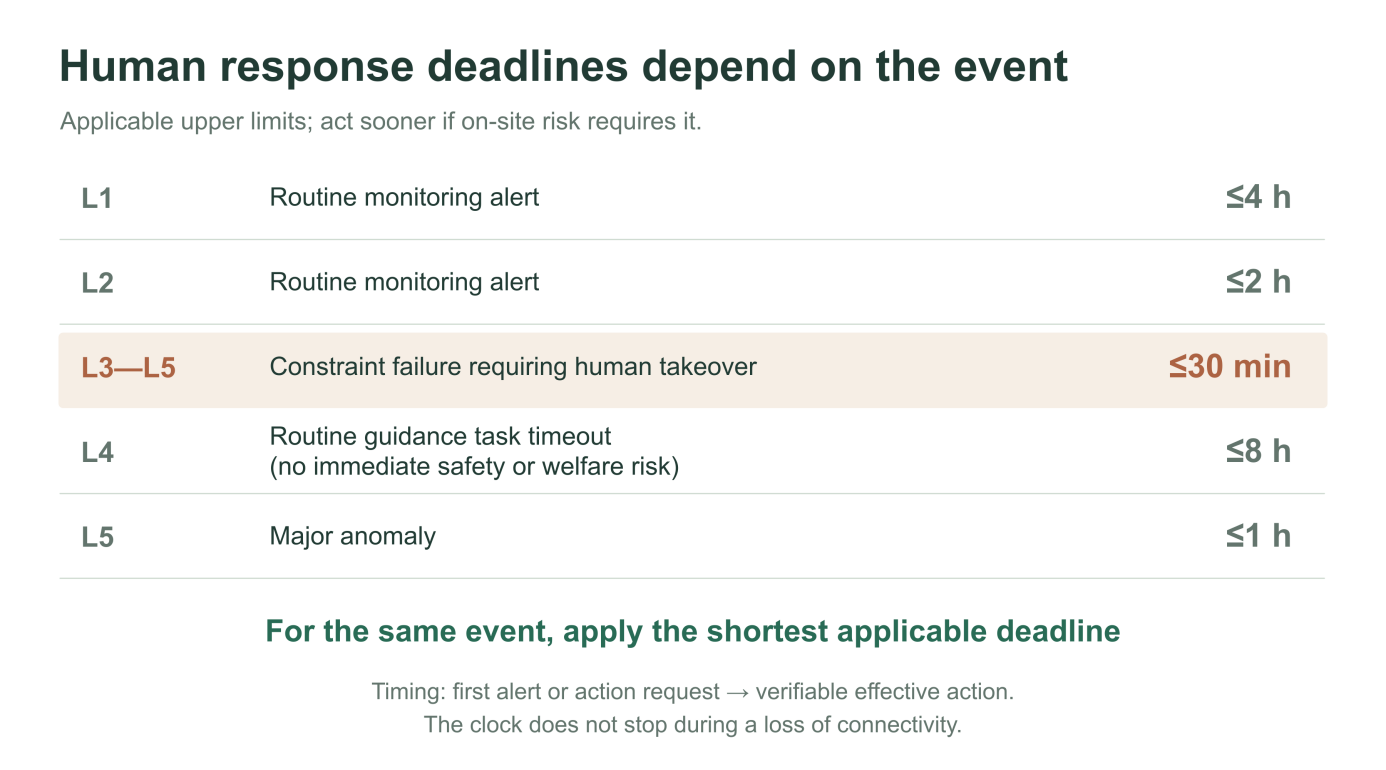
This is the most easily misread part of the whole table. It looks as though a higher level buys people more time, when in reality these two numbers describe entirely different kinds of event.
An ordinary guidance timeout is not in the same category as a boundary failure, blocked access to water or severe stress, and cannot be handled on the same clock. The 8 hours covers only the ordinary guidance timeout with no immediate safety or welfare consequence; it does not mean a herd in danger can wait 8 hours.
Once a constraint fails at L4 or L5, the 30-minute takeover rule applies just the same, and L5 carries a further 1-hour limit for major anomalies. Where one event falls under several rules, the shortest applicable limit wins.
The clock starts when the system first raises an alert or a handling request and stops when a person has done something verifiable and effective. Clicking “read” does not count as handling and a network outage does not stop the clock. Detection, delivery, confirmation, handling and risk clearance each leave a record.
Response time therefore follows the event and the risk, not the level number. The system first moves into a verified risk-mitigation state, people take over as required, and the whole chain still has to finish inside the safe time available on site. A higher level does not make the same danger any less urgent.
L5 Full-Domain Autonomous Grazing
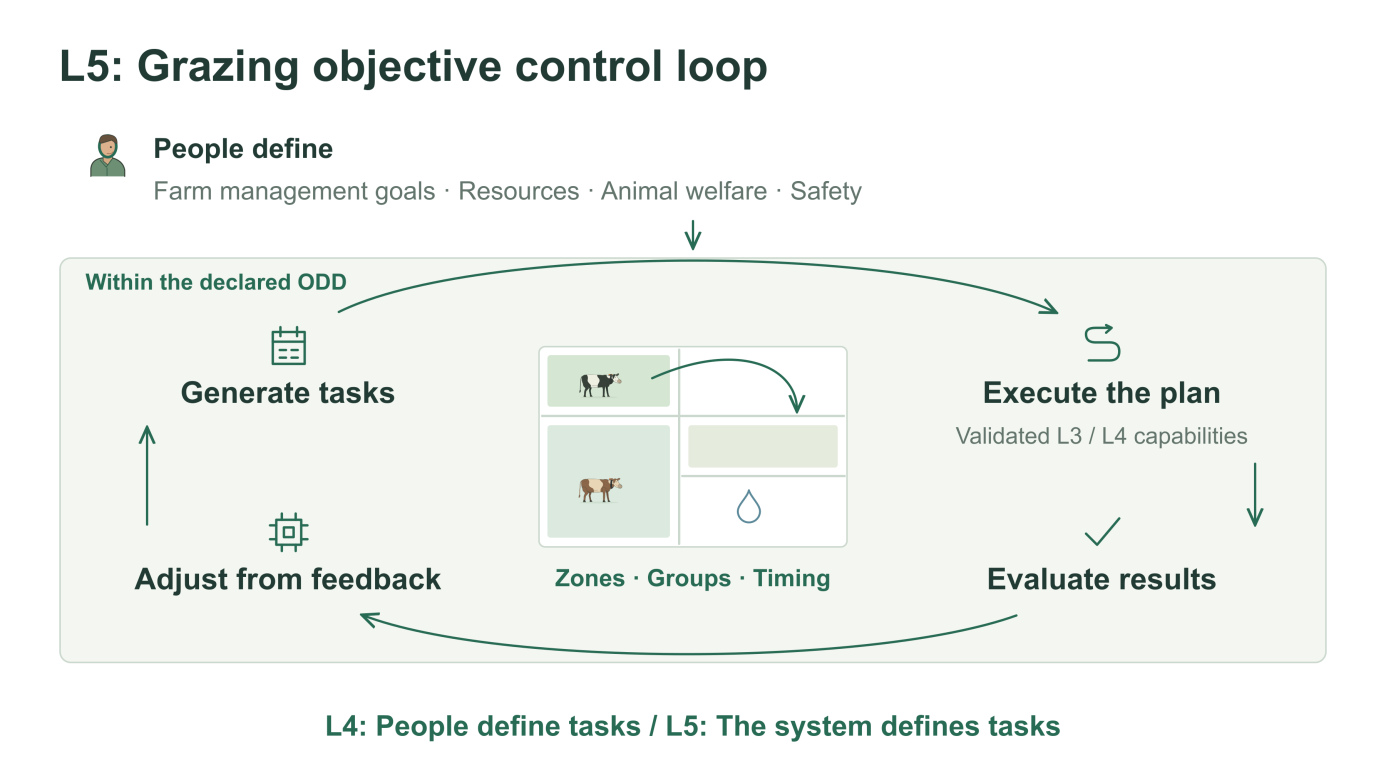
Closed loop: Grazing-objective closed loop. A person sets the operating objectives together with the limits on resources, welfare and safety; inside the declared ODD the system generates task objectives and grazing plans, executes them, evaluates them and adjusts as conditions change.
What the system handles: It decides how to zone the pasture, how to allocate herds and when to act, carries the work out through already-verified L4 and L3 capabilities, and adjusts on feedback from pasture resources and livestock status. Handing a person an advisory plan, or fine-tuning a few parameters, is not L5.
What people handle: Set the objectives and the constraints, supervise, and take over on anomalies; routine tasks are not scheduled or approved item by item. At L4 a person supplies the specific task, at L5 the system generates the objective itself. The dividing line is who sets the objective, not how big the ranch is.
The word “full domain” still has an edge to it. Capability across ranches, seasons and species is verified separately within the declared scope. Working for a cattle herd does not mean it works for a sheep flock, and it certainly does not mean every extreme-weather or disease scenario can be left to the system.
Verification thresholds: Plan achievement rate 90%; where associated learning is relied on, learning qualification rate 95%; the lower-level indicators must still be met.
The system boundary is at least Class II, and Class III only where automated facilities are in the loop. Energy self-sufficiency and maintenance-free intervals are verified separately: a level cannot be judged from one wearable terminal, and “L5” is not a promise that nothing ever needs maintaining.
Why L1–L2 Still Carry the Deployments
With the six levels laid out, look back at the ranches and the solutions actually running at scale still sit mainly in L1–L2. The reasons are practical: a ranch has to solve the task in front of it, and the investment, the network and the staffing have to keep up.
The cost has to add up. Grazing is a business of per-head cost multiplied by head count; a small difference in unit price, across several thousand animals, becomes a different sum altogether. Connectivity, training and maintenance cannot be left out either. In the end the question is whether the time saved and the losses avoided can carry the running cost of the whole solution.
The network has to hold up on site. On pastures with weak coverage, L2’s local recognition, strategy adjustment, offline recording and deferred upload often decide whether a solution keeps being used. Then come the follow-up questions: how long can it last offline, which remote services are lost, and who takes over the response?
People have to sit at the key nodes. “The system finds it, a person handles it” is a real division of labour: who takes the alert, who covers the shift, who can get to the site. If the device has found the anomaly and nobody picks up the message, the automation has failed at the last step.
Higher levels need matching preparation. Autonomous intervention, behaviour guidance and grazing-plan management each bring their own conditions. Facilities, training and emergency cover have to be checked item by item against the task and the risk; a level number on its own tells you very little.
So use the level you need now to the full, and move up when the need is real. Whether it pays is settled by field results and cost accounting; before upgrading, confirm that the new configuration, tasks and ODD all fall inside the verification already completed. A lower level solves real problems too, provided it is chosen well and run reliably.
Four Areas the V4 Standard Regulates Most Closely
1. Animal Welfare Covers Intensity, and the Whole Period of Use
Discussing autonomous intervention cannot stop at how strong the maximum stimulus is; the questions also include which animals it may be used on, how they are trained and who takes over when it fails. V4 constrains both intensity and use, and Appendix A sets out 13 clauses aimed at the details that matter on site.
- Aversive stimulus devices must not be deployed on young livestock;
- Virtual boundaries must be paired with a verified perimeter fence or other safety safeguard;
- Boundary adjustments must verify movement speed, buffer distance and acclimatisation time;
- Continuous access to drinking water and to essential resources must be ensured;
- Wearing-related injury risk must be assessed, with equipment inspection, staff training and emergency takeover in place.
These clauses answer concrete questions: can the device injure an animal, can the animal adapt, and is there cover when something goes wrong. Technical feasibility is always read together with those conditions.
2. Lead Animals Moving the Whole Herd: Coverage Has to Rest on Measured Results
Whether fitting devices to a few animals can move an entire group is a cost question every ranch asks. V4 standardises the control coverage ratio as the minimum verified wearing proportion: at L3 and above it is declared from measured results, not against a uniform 90%, 60% or 50% threshold, and lead-animal identification is not a necessary condition for L3 either.
L4 may use a fully fitted herd or a partially fitted one. But where lead animals are expected to move the group, replacement of lead animals, regrouping, stragglers and device failure all have to be verified, and what is evaluated is the whole target group. Deployment must not fall below the declared ratio, and a few fitted cattle arriving does not make a whole-herd task complete.
3. Battery Life and Maintenance Are Separate Accounts; a Level Is Not a Promise
However clever the device, if cattle have to be caught for battery changes, the labour saved can be spent right there. Battery swaps, inspection, repair, upgrades and the need for manual handling must therefore be stated clearly in the declaration.
Energy self-sufficiency and maintenance-free intervals are additional capabilities and do not by themselves establish L5. A claim of “12 consecutive months without gathering the herd for battery changes” needs measured evidence behind it; solar panels are not the same thing as operational verification, and the 12-month verification period for L5 does not mean 12 months without maintenance.
4. Six-Step Determination Plus Disqualification: a Level Cannot Be Self-Declared
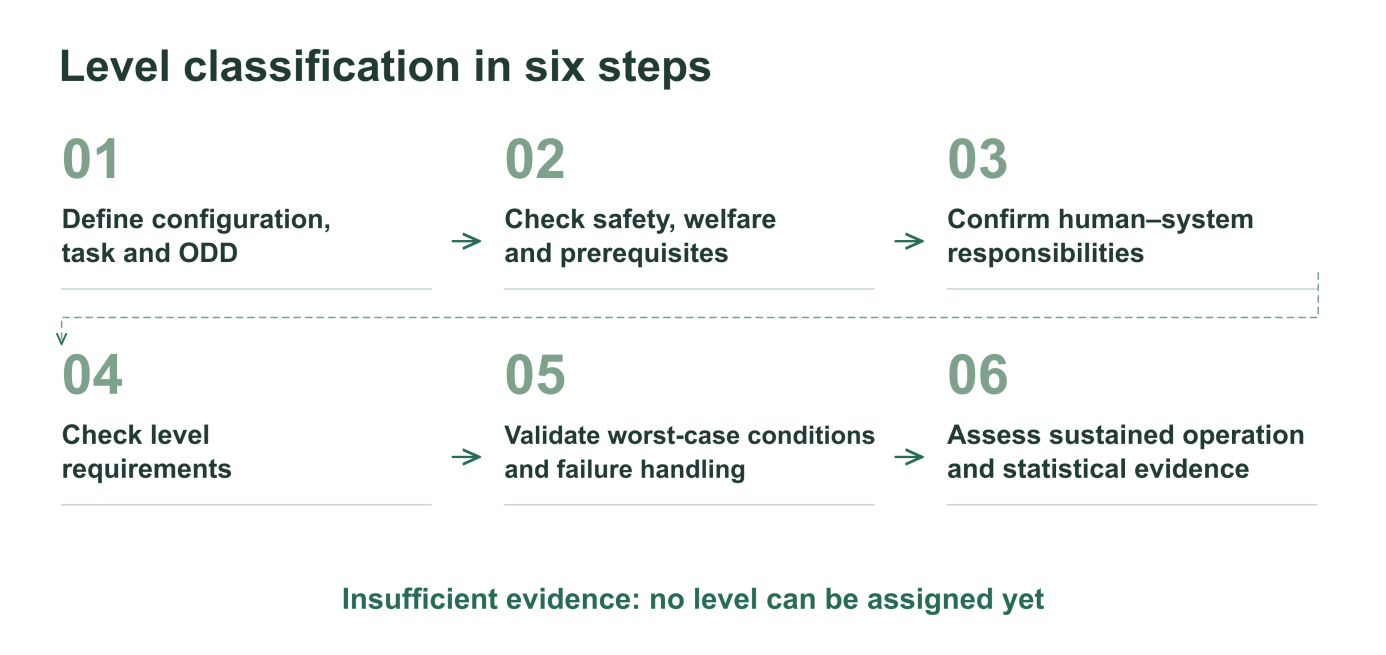
Determining a level takes six steps: define the configuration, tasks and ODD; check safety, welfare and baseline conditions; confirm the human-machine division of labour; check against the candidate level; verify the most adverse conditions and failure handling; then complete the continuity and statistical determination.
In plain terms: say which system is being assessed, what it is meant to do and where; then see whether it can do the work on its own and what happens when conditions turn bad; then prove it with continuous operation and statistics.
The disqualifications are equally blunt. An unclear configuration or ODD, safety or welfare controls that are not passed, stimulus limits missing or breached, key records that cannot be trusted, insufficient evidence, or an inability to demonstrate the necessary alerting, human takeover and degradation all mean no grade.
Nor can a failed system simply slide down a level. Applying for a lower level still requires fresh verification; where evidence is short, no level is assigned for the time being; and any function involved in a safety or welfare violation is suspended, corrected and re-verified.
How long to test and how many animals to test are also fixed by level.
- L0 and L1: at least 30 days and 30 head;
- L2, L3 and L4: at least 90 days, with no fewer than 30, 50 and 100 head respectively; two seasonal conditions in principle, and a single-season limit only under special requirements that are clearly declared;
- L4: at least two independent groups, plus verification of the largest single-instance group;
- L5: at least 12 months, 200 head and three ranches, with each declared species verified separately.
Enough animals is not the same as enough evidence. Proportional indicators must reach the required one-sided 95% confidence lower bound; the minimum head count cannot stand in for statistical sufficiency, and one good-looking success rate is not a result.
Appendix C adds market-access checks for different destinations, and level verification does not replace local admission requirements. High-intensity modules must be capable of being switched off independently, with complete and verifiable logs kept for at least three years; after switch-off the declaration is re-verified against what the system can still do.
How Fullanim Products Map to the Levels: Delivered by Scenario, Not Stacked by Grade
As the author of this specification, Fullanim covers several levels from L1 to L4. The volume leader, and the product on the widest range of ranches, is the L2-grade lightweight smart ear tag. In practice it looks like this.
Note: the levels below are each subject to the corresponding ODD declaration, system boundary class, degradation path and verification report; see the level declaration for each product.
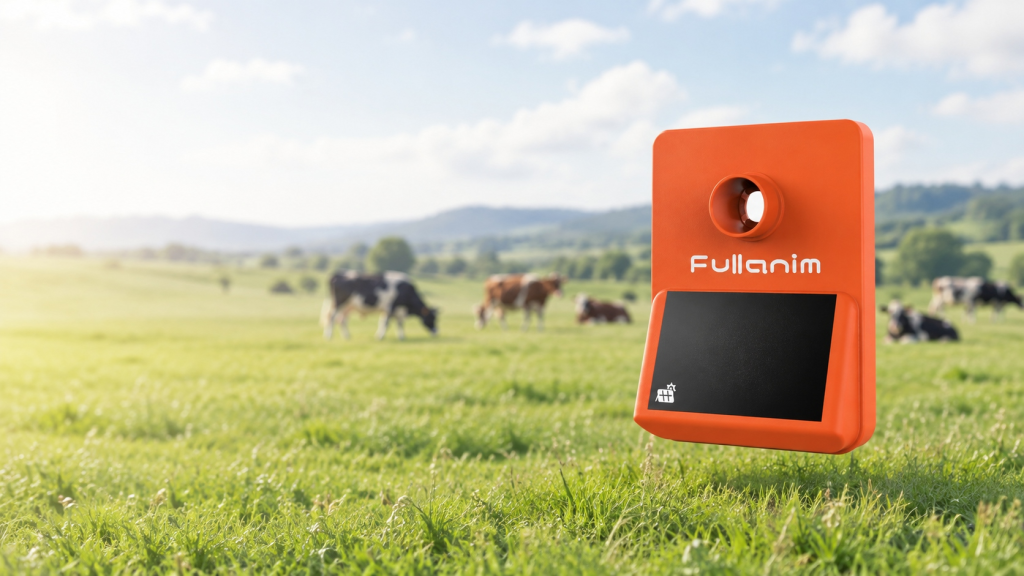
Lightweight smart ear tag T005 (L2) — the flagship. Under 20 grams, with edge-side anomaly monitoring, deferred upload after network loss and long endurance, aimed at large-scale extensive grazing and transhumant herds. What it settles first is continuous monitoring and timely detection.
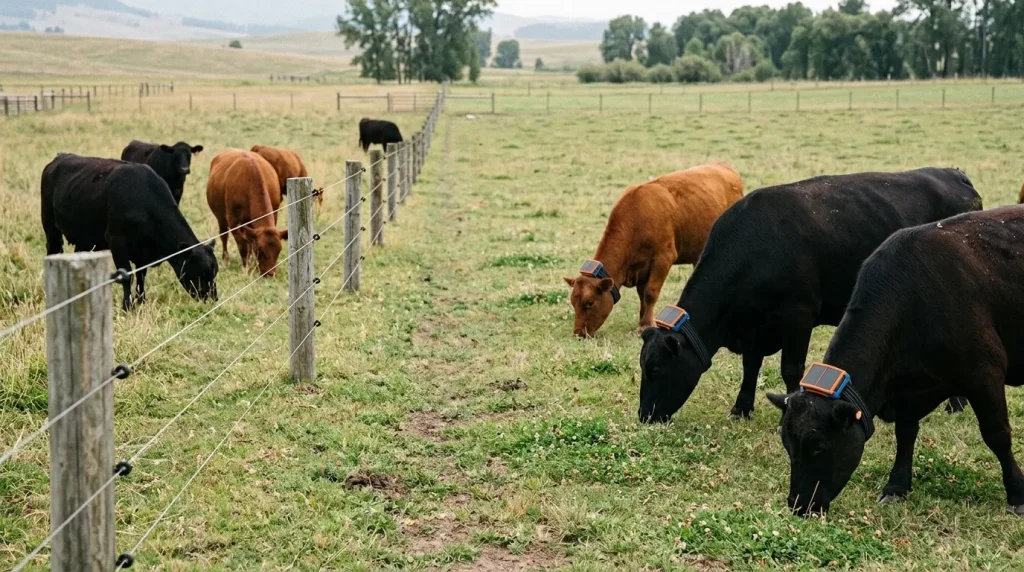
Virtual fencing collar (L3) — built for ecologically sensitive areas and strict boundary control, centred on graded intervention and low-stress handling, while observing stimulus limits, training eligibility and on-site safeguards.
L4 herd guidance solution — for medium and large ranches that need rotation, segregation and recall. It is being deployed and verified on several ranches at home and abroad, exploring low-cost herd scheduling through lead animals; the final capability and scope follow the verification results.
From building products to writing the standard, Fullanim holds one view: the point of grazing intelligence was never how high a level can be reached, but that every unit of money a ranch spends lands on the right level.
Releasing this V4 standard is both a constraint Fullanim puts on its own products and a reference for the industry, moving the field from competing on parameters and concepts towards stating clearly, choosing correctly and using well.
Intellectual Property Statement
1. All intellectual property rights in this article, and in the project schemes, hardware and software systems, algorithms and the like involved, belong to Hangzhou Fullanim Technology Co., Ltd.
2. The Automation Grading Specification for Grazing Smart Wearable Systems (V4) has completed filing, and the related intellectual property rights have been filed for application.
3. Reproduction, copying and commercial use are prohibited without written permission.
4. For partnership discussions and content licensing, please contact us.
5. Contact: Manager Zhang, 18989896779.
©2026 Fullanim Fullanim. All rights reserved.


 Contact us by email