

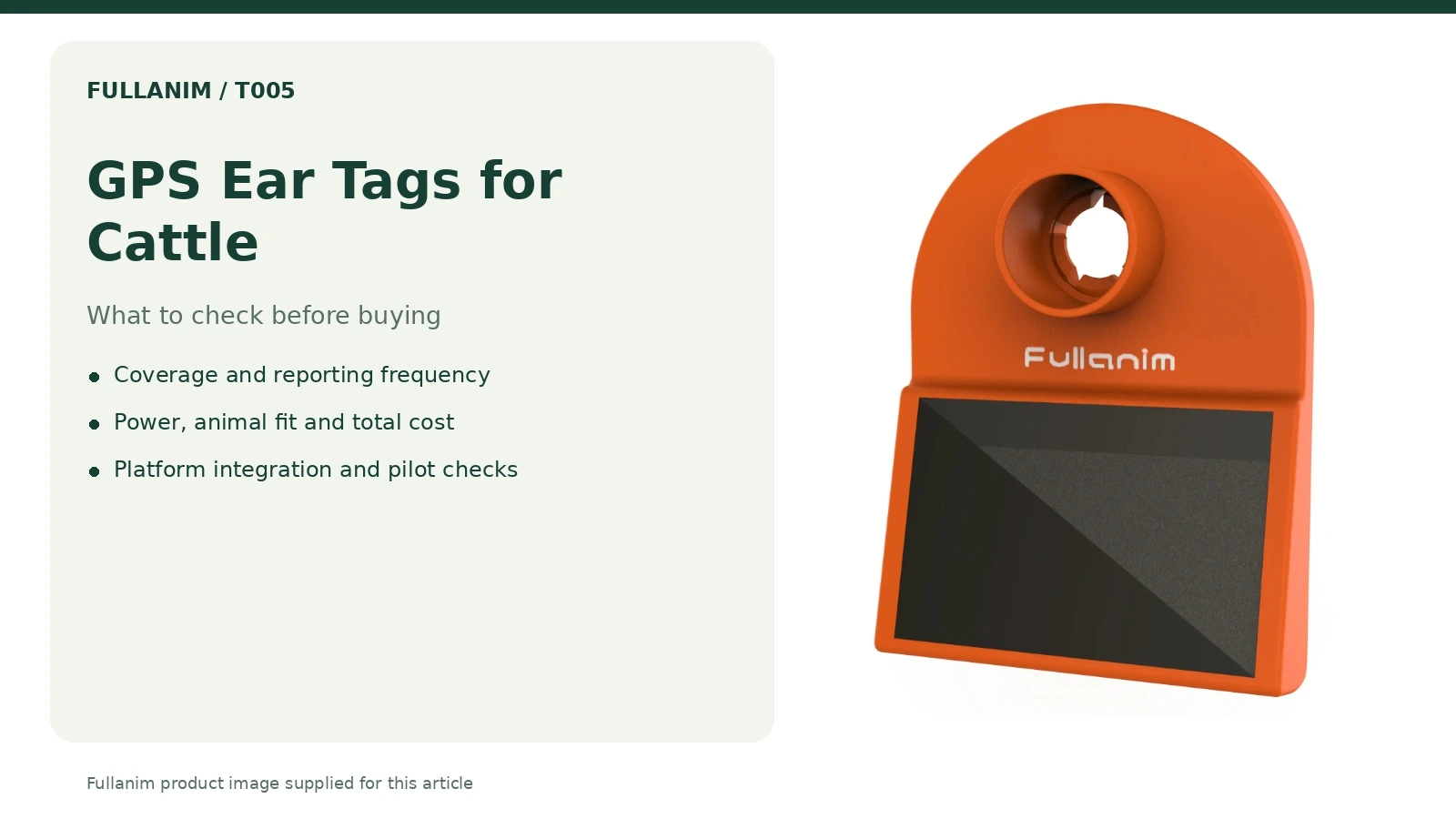
GPS Ear Tags for Cattle: What to Check Before Buying
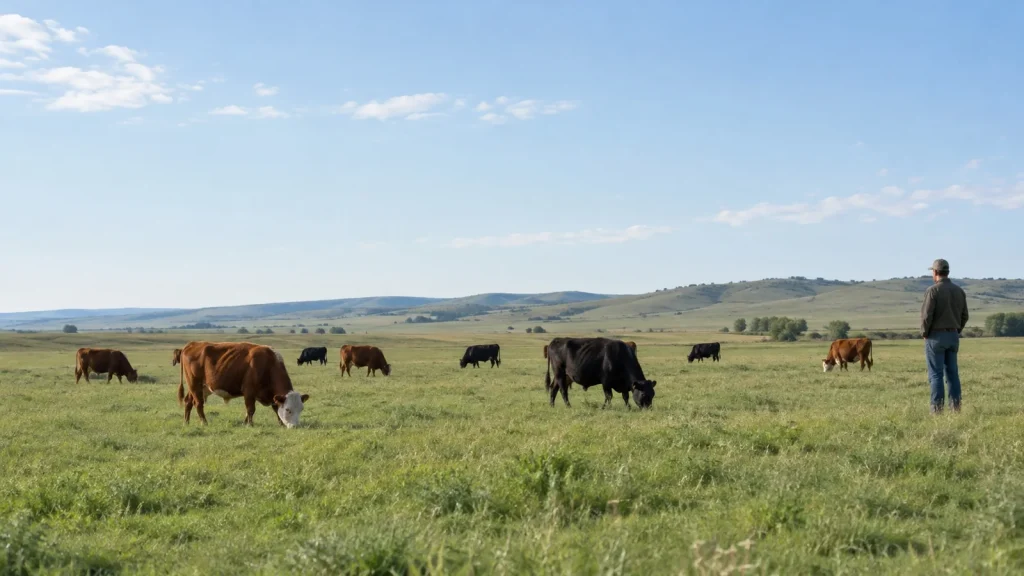
Finding cattle across a large grazing area takes time. A location on a map can give the team a useful place to start—but only if the device has reported recently and the system works where the animals actually roam.
GPS ear tags for cattle combine location reporting with wireless communication. Some also collect activity data. Before buying, compare the complete setup: coverage, update frequency, power requirements, animal fit, platform access and ongoing costs—not just the tag price.
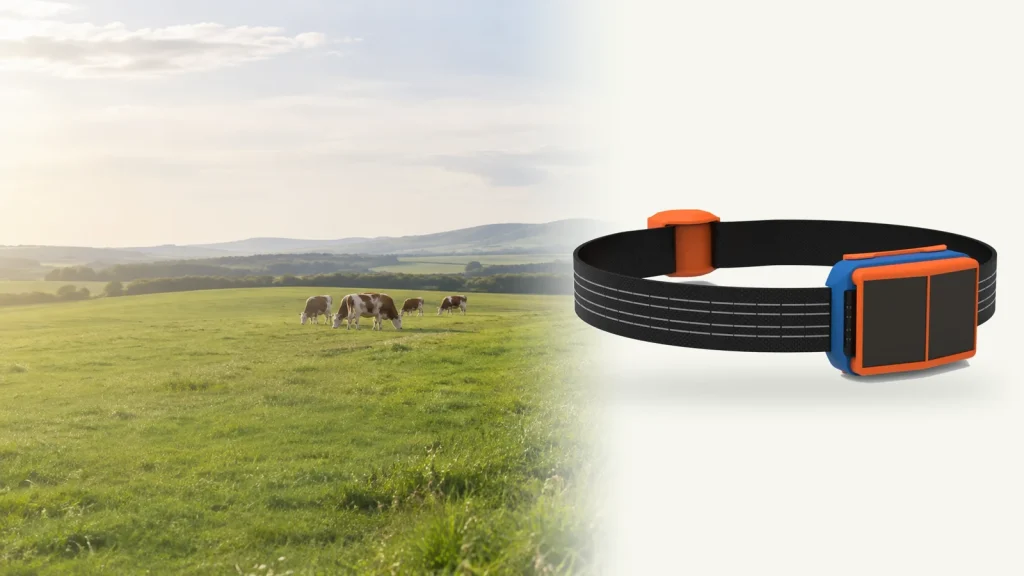
The Fullanim T005 GPS Ear Tag is one option for projects built around shared LoRaWAN gateway coverage. It combines light energy harvesting with location, herd inventory and behavior-monitoring functions. The questions below help you assess whether that approach fits your operation.
Start With the Job You Need Done
What should the farm team be able to do differently after the tags are installed?
Perhaps the priority is locating animals before a pasture check. It might be reviewing herd distribution, keeping animal records organized across grazing areas, or following up on changes in daily activity.
Choose one or two priorities before comparing features. A system selected for occasional location checks may have different requirements from one intended to support frequent operational decisions.
Write down who will use the information, how current it needs to be and what action follows. That gives the supplier something concrete to assess—and gives your team a way to judge the pilot.
Will Coverage Reach Your Cattle?
GPS positioning and data transmission are separate jobs. The positioning receiver calculates a location; a communication link carries the report to the platform.
With T005, that link is LoRaWAN. Tags send reports to a compatible gateway, which forwards them through the project’s internet connection and server infrastructure. The LoRa Alliance’s explanation of LoRaWAN describes this gateway-based architecture.
This means each T005 tag does not need its own cellular SIM. However, the gateway still needs power and a connection back to the servers. Depending on the site, that backhaul connection may use Ethernet, 4G or a satellite internet service.
Fullanim lists a nominal tag-to-gateway range of about 5 km in open areas. Treat this as a starting point for site planning, not a guarantee that one gateway covers every paddock inside a 5 km radius.
Before deciding how many gateways to install, identify the areas cattle actually use and test them. Include sheltered corners, routes between paddocks and locations furthest from the proposed gateway.
For a fuller explanation of the data path, read how GPS cattle ear tags work.
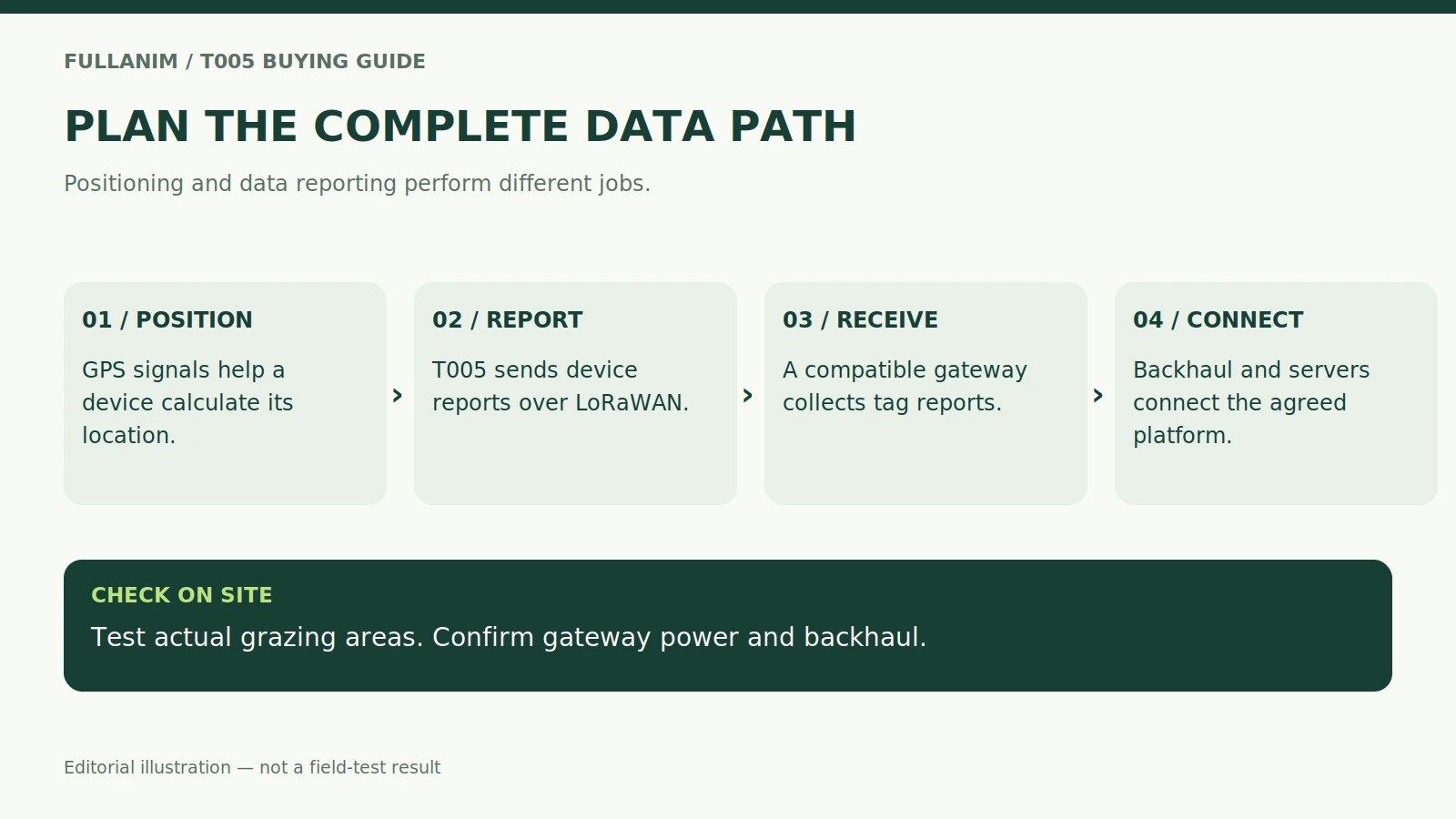
Illustrative architecture. Validate actual grazing-area coverage, gateway power and backhaul.
How Recent Are the Locations?
When a supplier says “tracking,” ask how often the map receives a new location.
T005’s default reporting interval is 15 minutes. That supports periodic location updates, rather than a continuous, second-by-second view of an animal’s movement.
Picture someone heading out to find a cow. A map position is more useful when it also shows when the device last reported. An older position should not be mistaken for the animal’s current location.
During evaluation, check whether the reporting interval fits your workflow. Also ask how the platform handles missing reports, how it marks stale information and what happens after a connectivity interruption. Do not assume offline storage or automatic recovery without confirming the device’s behavior.
Position accuracy is another separate question. As GPS.gov explains, signal blockage, the surrounding environment and receiver design can affect accuracy. Test whether the location information is useful in your grazing environment rather than relying on an unrelated GPS accuracy figure.
How Will You Keep Tags Powered?
Charging a device on a desk is easy. Servicing devices on a dispersed herd is a different task.
T005 uses light energy harvesting to replenish power while illuminated, including light beyond direct sunlight. This can help reduce manual charging and battery-replacement work.
The practical question is whether the available light supports the intended operating pattern. Cattle spending long periods under cover will present different conditions from cattle grazing in open paddocks.
Fullanim publishes a nominal five-year service life for T005 and calls for validation of light exposure, reporting settings and deployment conditions. That figure should not be confused with a five-year warranty or a promise of unlimited operation in darkness.
For a pilot, review power performance alongside reporting reliability. If low-light periods are important to the operation, ask the supplier how they should be evaluated before rollout.
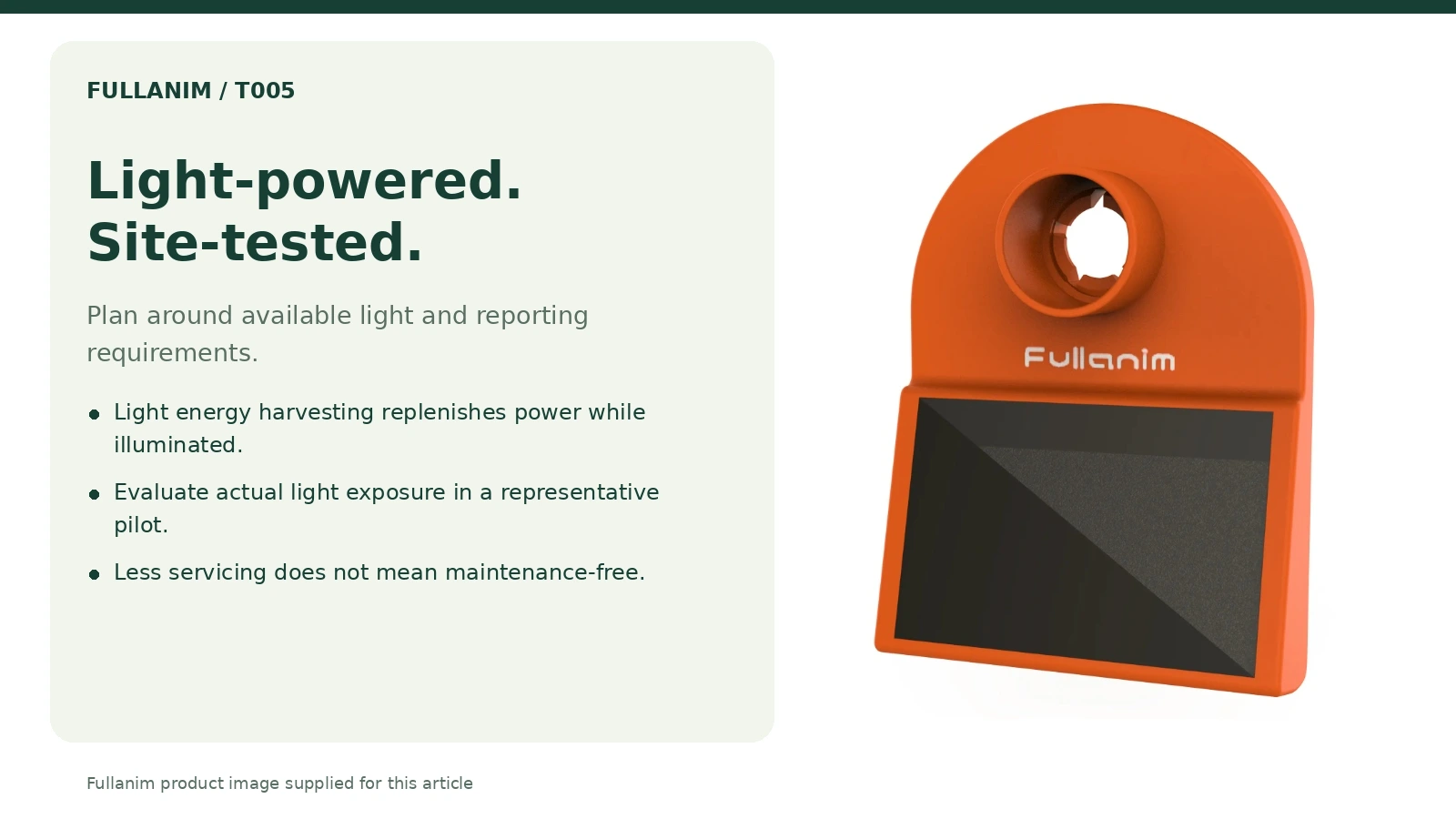
T005 uses light energy harvesting. Evaluate available light and reporting requirements in a representative pilot.
Does the Tag Fit the Animals?
A cattle tracker is also something the animal has to wear.
T005’s published weight is 16.5 ± 0.5 g. Weight is worth comparing, but it should not be the only fitting criterion.
Ask about the recommended attachment procedure, suitable animal groups, applicator requirements and checks after fitting. Evaluate the intended cattle rather than assuming one fitting method suits every breed, age and management system.
Include tag retention and the condition of the attachment site in your pilot observations. A useful location report does not remove the need for appropriate fitting and routine animal checks.
Which Extra Features Are Included?
“Smart ear tag” can describe very different products. Do not assume every tag provides temperature, rumination, breeding or disease-detection functions.
T005’s published behavior information includes lying, walking and daily activity. These records can help a team review patterns and decide which animals deserve a closer check. They are not, by themselves, a veterinary diagnosis.
Fullanim also lists automatic livestock counting and electronic boundary monitoring. Before relying on those functions, agree on how they will work in the project platform.
For inventory, ask what the displayed count represents: registered tags, recently reporting animals or animals assigned to a selected area. Decide how removed tags, stale reports and animal-to-device assignments will be handled.
For boundaries, confirm the reporting and alert workflow. Boundary monitoring should not be assumed to mean the ear tag actively contains cattle or replaces physical fencing.
What Is the Full System Cost?
When comparing GPS ear tags for cattle, ask for a project quote—not just a price per tag.
For a T005 deployment, the budget should address:
- Ear tags and attachment accessories
- Compatible gateways, installation and power
- Gateway internet backhaul
- Network-server and application services
- Platform setup, data integration and user access
- Local support, maintenance and replacement arrangements
No cellular SIM in each tag does not mean the system has no connectivity or service costs. Likewise, a quote for hardware does not automatically include every software feature or subscription.
Ask the supplier to separate one-time costs from recurring charges and explain who provides each part. If multiple grazing sites are involved, request a site-by-site infrastructure assessment rather than assuming the same gateway arrangement will work everywhere.
Where the Fullanim T005 Fits
T005 is worth evaluating when a project needs a lightweight ear-mounted device, periodic location reports and a shared LoRaWAN network. Its light-powered design is particularly relevant when reducing hands-on power servicing is a priority.
| Published T005 specification | What to check in your project |
|---|---|
| LoRaWAN connectivity | Compatible gateways, local coverage and backhaul |
| Light energy harvesting | Actual light exposure and operating requirements |
| 16.5 ± 0.5 g weight | Fitting procedure and suitability for the intended cattle |
| Default reporting every 15 minutes | Whether that interval suits the management task |
| Nominal open-area range of about 5 km | Coverage across the actual grazing areas |
| Nominal service life of five years | Operating conditions and separately agreed warranty terms |
| Location, inventory and activity functions | Data definitions, platform features and follow-up workflows |
For platform companies and local service providers, the integration scope matters as much as the hardware. Fullanim supplies livestock devices and supports custom development, device communication, data interfaces and customer-platform integration.
Its livestock tracker partner program is aimed at integrators, connectivity providers, IoT platforms and distributors. Confirm who will handle local installation, connectivity, customer onboarding and ongoing support before committing to a rollout.
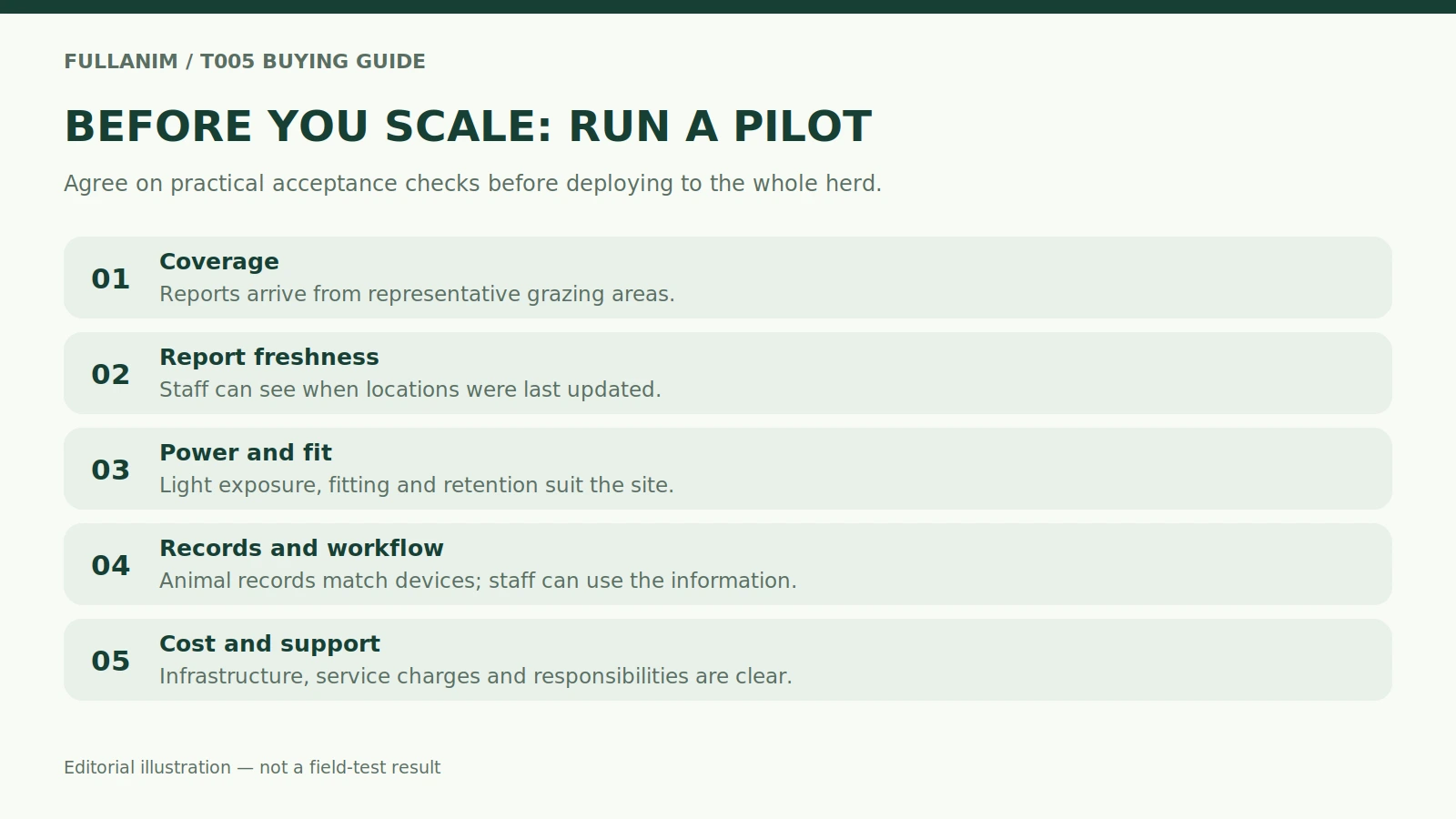
Agree on pilot acceptance checks before scaling the deployment.
Run a Pilot Before Scaling
A pilot should help you make a purchasing decision, not simply demonstrate that a tag can appear on a map.
Use a manageable group of animals in representative grazing areas. Agree on the checks in advance:
- Reports arrive from the places cattle actually use
- Location timestamps are visible and useful
- Power performance matches the available light and settings
- Tag fitting and retention suit the selected animals
- Animal records stay linked to the correct devices
- Farm staff can use the information for the intended tasks
- Support and integration responsibilities are clear
Record the results and any changes needed before increasing quantities. This creates a more useful basis for rollout than a specification sheet alone.
Frequently Asked Questions
Can GPS ear tags work without cell coverage?
Some can. T005 uses LoRaWAN between tags and gateways, so cellular coverage is not required at every animal’s location. Suitable LoRaWAN coverage and a working gateway backhaul are still needed. If the gateway uses 4G backhaul, it needs compatible mobile coverage at its own location.
Are light-powered tags maintenance-free?
No. Light energy harvesting can reduce power-servicing work, but fitting, retention, connectivity and operating conditions still need attention. For T005, validate light exposure and reporting requirements rather than assuming every lighting condition supports the same performance.
How much do GPS ear tags for cattle cost?
A meaningful comparison includes the tags, receiving infrastructure, connectivity, software and support. For T005, request a quote based on the deployment country, tag quantity, grazing layout and platform requirements, with recurring charges listed separately.
Can T005 connect to an existing platform?
Fullanim supports data interfaces and platform integration. Share the required data fields and platform details so the available interface, development scope and responsibilities can be confirmed. Compatibility should not be assumed before a technical review.
Discuss Your Cattle Tracking Project
Share your deployment country, herd size, grazing layout, available internet connection and reporting needs. If you already have a livestock platform, include its integration requirements too.
That gives Fullanim and your local deployment team a practical starting point for evaluating coverage, hardware quantities and integration work.



 Contact us by email