

Livestock GPS Ear Tags vs. Tracking Collars: How to Choose for Your Project
Should your livestock project use ear tags or tracking collars? The answer depends on what you need to monitor, where animals move and how device data reaches your platform.
Conventional BLE smart ear tags are often used for livestock asset monitoring in confined areas, while 4G tracking collars are commonly considered for open grazing. Fullanim’s T106 and C106 offer another approach. This guide explains the conventional comparison, then explores how their designs change the options for integrators, operators and platform providers.
Conventional ear tags vs. tracking collars
BLE smart ear tags help identify and monitor individual animals in barns, pens and other managed areas. They can support inventory and sensor-based monitoring, depending on the model. Animals need to remain within receiver coverage for new data to reach the system.
Tracking collars are worn around the neck and commonly used in free-range or grazing operations. Many positioning collars use GPS or another satellite positioning system, then transmit data through 4G. This provides location visibility wherever compatible cellular coverage is available.
| Factor | Conventional BLE smart ear tags | Conventional 4G tracking collars |
|---|---|---|
| Common setting | Barns, pens and confined operations | Open grazing and free-range operations |
| Main purpose | Individual identification, inventory and livestock asset monitoring | Location tracking; additional functions vary by model |
| Communication | BLE to a nearby gateway or receiver | 4G connection to a mobile network |
| Coverage requirement | Animals remain within local receiver coverage | Compatible mobile signal where animals report |
| Deployment consideration | Receiver placement and battery maintenance | Cellular provisioning, data service and collar fit |
For the BLE deployments considered here, reference distances are approximately 200 m in open areas and 80 m inside livestock housing. These are not universal BLE limits: antennas, buildings, obstructions and gateway placement affect actual range. Extending this architecture across a pasture may require additional receivers.
With a 4G collar, the constraint is different. Mobile coverage may be available near farm buildings but inconsistent elsewhere. The collar may obtain a position while being unable to transmit a new report. Each device’s cellular service and ongoing charges also need to be considered.
However, traditional uses do not define every ear tag’s potential. Fullanim’s T106 expands what an ear tag can do and where it can be used. Its design provides a different starting point for grazing projects.
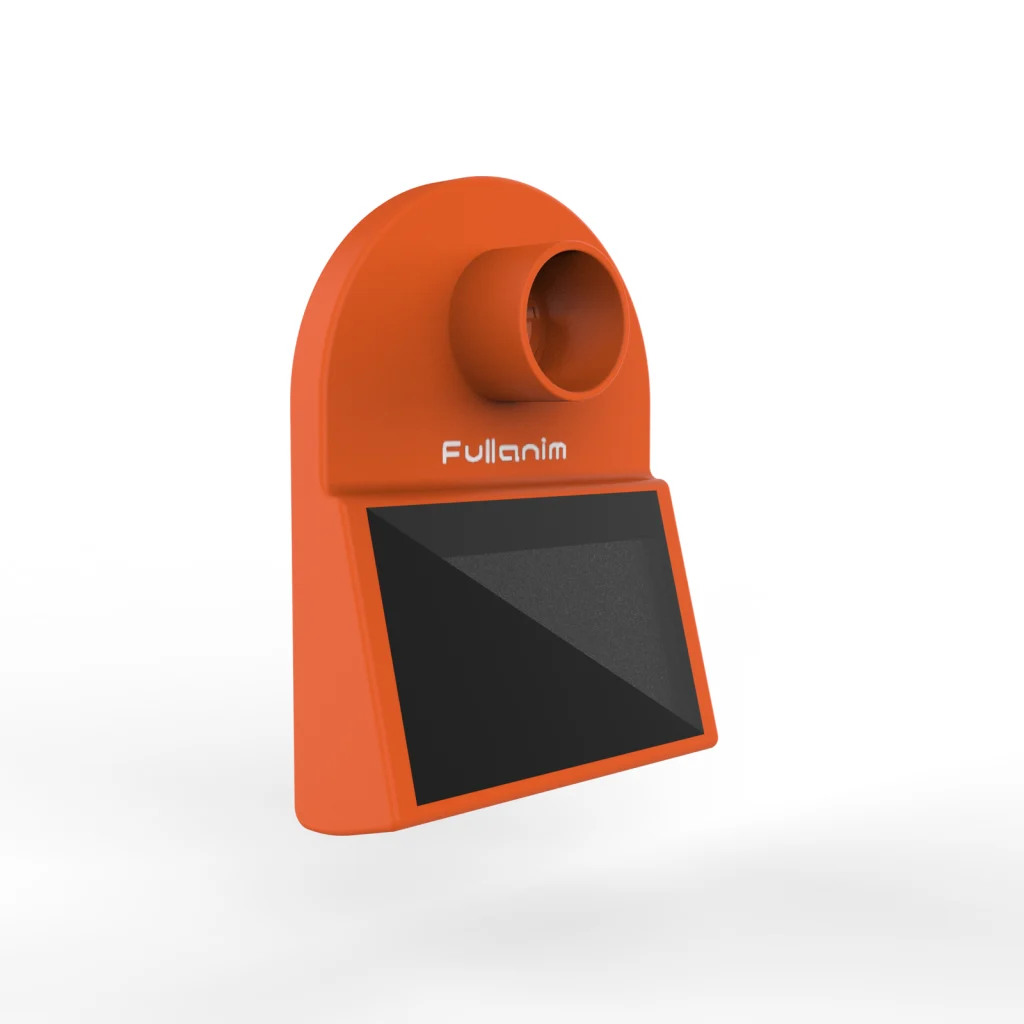
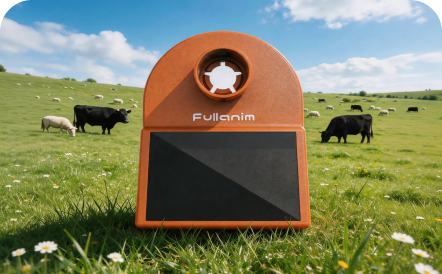
Fullanim T106 combines LoRaWAN communication, solar energy harvesting and a lightweight ear-mounted design. Together, these features address coverage and power management when animals move beyond confined areas.
Longer-range communication
T106’s nominal ear-tag-to-gateway range is approximately 5,000 m in open-area conditions. Compared with the close receiver footprint of the BLE deployments described above, this creates an opportunity to plan monitoring across larger grazing areas with fewer closely spaced receiving points.
For integrators, this opens a wider range of applications: grazing livestock, multi-area herd inventory and connected monitoring beyond the barn. Animals can move within the project’s LoRaWAN coverage while their data reaches the platform through shared gateways.
Solar power for field operation
Tags powered only by a finite battery, or requiring manual charging, introduce maintenance tasks. Those tasks become more demanding when animals range over a large area.
T106 harvests light energy to support operation outdoors, helping reduce dependence on routine battery replacement or charging under suitable light conditions. Its nominal service life is five years, supporting projects designed for long-term field use.
A light wearable with connected data
At 16.5 ± 0.5 g, T106 retains the light ear-tag format while supporting location, dynamic inventory and activity data. Its default reporting interval is 15 minutes, providing regular updates for herd visibility and management.
These functions help connect individual animal records with what is happening in the field. Partners can use location, inventory and activity trends in grazing, finishing and herd management workflows, giving customers more information than an identification record alone.
For a local integrator or platform provider, the advantage is the combination: wider communication coverage, outdoor energy replenishment and a light individual wearable. T106 brings the practical ear-tag format into grazing applications as well as confined livestock management.
C106: a LoRaWAN alternative to 4G tracking collars
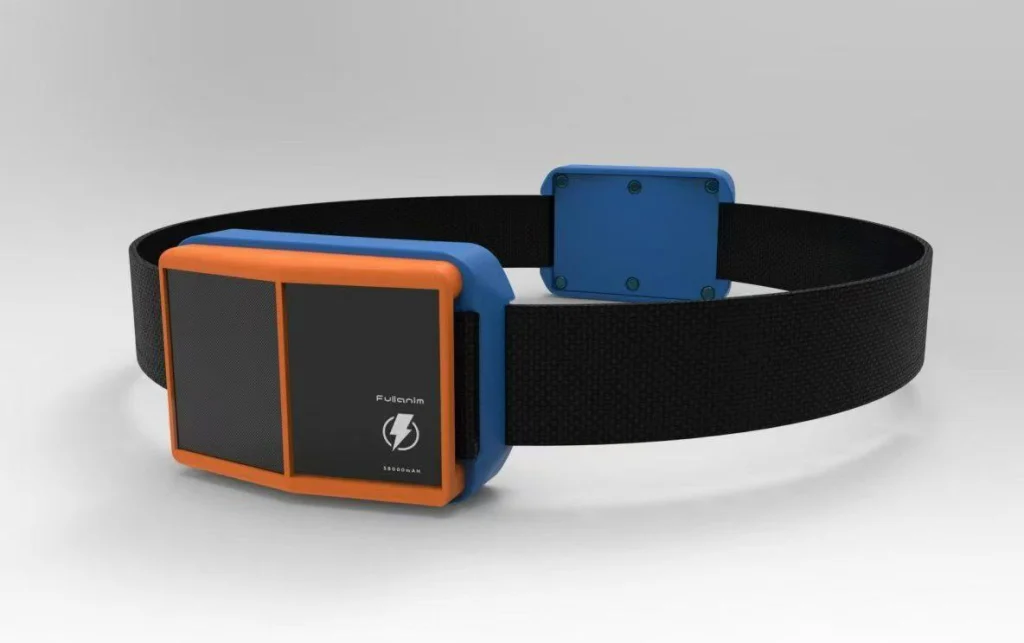
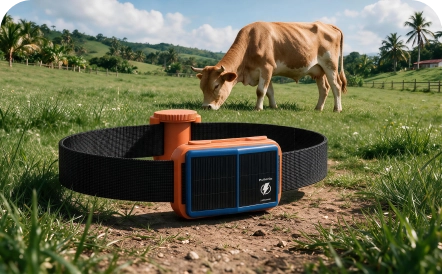
Fullanim C106, also known as FL-C106, combines BeiDou/GPS positioning, LoRaWAN communication, solar power and a virtual fencing response workflow.
GPS and BeiDou determine position; LoRaWAN carries data. C106 retains satellite positioning while changing how the collar communicates with the project network.
Gateway connectivity instead of a 4G link on each collar
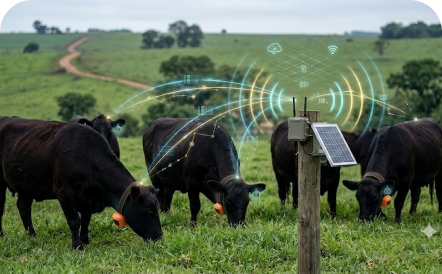
A conventional 4G collar sends data through the mobile network. C106 sends data to a compatible LoRaWAN gateway, which forwards it to servers and the application platform.
This gives partners another way to serve pastures with uneven mobile coverage. Local LoRaWAN gateways connect the collars, while backhaul can be selected at gateway sites using available 4G, Ethernet or satellite internet services.
For multiple collars, connectivity can be managed through shared gateways instead of a separate cellular subscription for every wearable. This can reduce per-collar cellular charges and consolidate connectivity management at the gateway level, giving local partners more flexibility when designing a livestock solution.
Solar power and boundary response
C106’s solar-powered design supports a nominal operating period of 60 months. Combined with BeiDou/GPS positioning, with a reference accuracy of 5–10 m, it provides a hardware foundation for long-term grazing and boundary-management projects.
Its virtual fencing workflow goes beyond displaying location points. It uses a sound prompt as an animal approaches a boundary, strengthens the audible alert at a first crossing, handles continued crossing according to the configured project strategy, and stops reminders and archives the event when the animal returns.
This connects positioning with active boundary response. Staff can review recorded events alongside location information, supporting grazing management and follow-up. The sound-first approach is a key part of C106’s design.
Which product fits your project?
The choice should follow your management objective rather than a simple rule that ear tags belong indoors and collars belong outdoors.
| Project priority | Product to evaluate | Reason |
|---|---|---|
| Individual monitoring and inventory across grazing areas | T106 | A light ear tag with LoRaWAN connectivity and solar energy harvesting |
| Location and activity trends alongside herd records | T106 | Connected data supports inventory and management workflows |
| Positioning and virtual boundary response | C106 | BeiDou/GPS, audible prompts and boundary event records |
| An alternative to individual 4G collar connections | C106 | LoRaWAN gateway connectivity supports a different deployment architecture |
Both products use a common architectural approach:
Device → LoRaWAN gateway → backhaul → servers → Web / App platform.
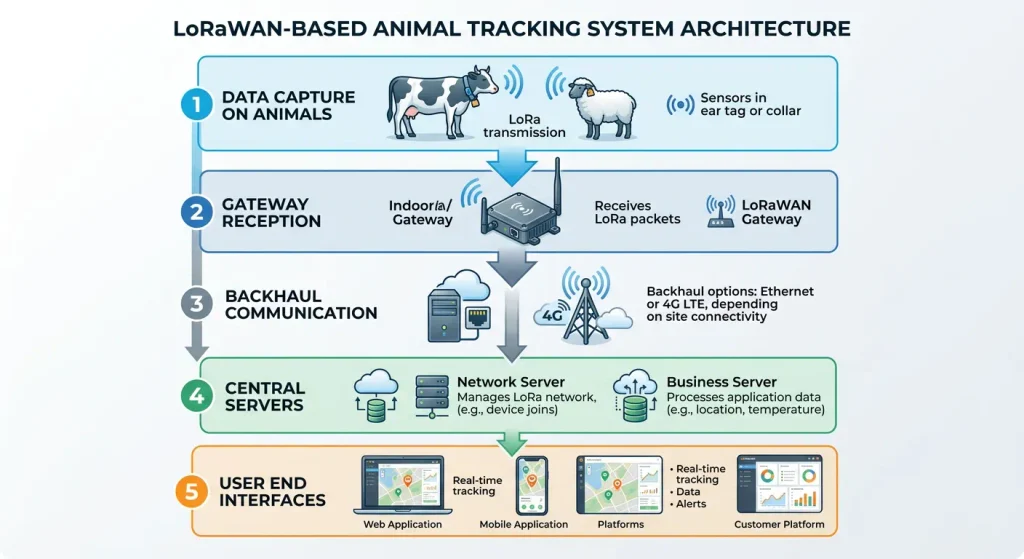
For partners offering both product categories, this creates a common framework for coverage and platform planning. T106 can support individual monitoring and inventory, while C106 adds positioning and boundary response, allowing partners to build a product offering around different customer needs.
From comparison to project planning
Conventional BLE ear tags and 4G tracking collars remain useful in the environments their networks suit. Fullanim extends the choice: T106 brings LoRaWAN and solar power to a lightweight ear tag, while C106 combines gateway connectivity with positioning and virtual fencing functions.
Fullanim works with integrators, connectivity providers and platform companies on hardware supply and OEM/ODM cooperation. T106 and C106 give partners two complementary hardware options for developing livestock services in their local markets, from individual animal monitoring to connected grazing management.
Contact Fullanim to request the T106 and C106 product catalog or discuss your project requirements.


 Contact us by email